As an Amazon Associate, Oxymeter earns from qualifying purchases. Product links may be affiliate links — the price for you stays the same.
Short answer: yes, but with an asterisk the size of a base camp tent.
A pulse oximeter doesn't diagnose altitude sickness. What it does is measure the thing that altitude sickness rides in on — your blood oxygen saturation, the SpO₂ number. And here's the useful part: that number often starts falling before you feel anything wrong. You're sipping tea at the hut, feeling fine, and your fingertip says 81%. That's the device doing its job. It's seeing the squeeze before your head does.
So the honest framing is this. The oximeter is a smoke detector, not a fire marshal. It tells you something's heating up. Whether it becomes a real fire — acute mountain sickness, or worse — depends on what you do next.
What the number is actually telling you
Every metre you climb, atmospheric pressure drops. The air is still 20.9% oxygen — that never changes — but there are fewer molecules packed into each lungful. At 3,500m you're pulling in roughly 65% of the oxygen you'd get per breath at sea level. At 5,000m, just 53%.
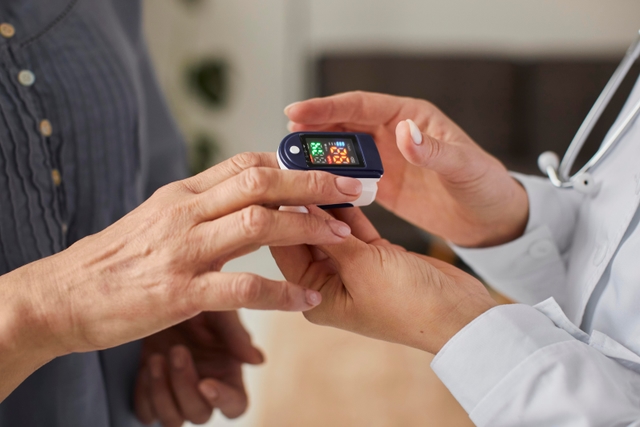
Your blood responds in real time. SpO₂ is the percentage of your haemoglobin carrying oxygen, and as the air thins, that percentage slides. A pulse oximeter clips onto your finger, shines red and infrared light through the tissue, and reads how much of each colour the blood absorbs. From that it calculates saturation. Cheap ones cost less than a decent pair of gloves and read within a couple of points of hospital-grade kit when used right.
The catch is interpretation. A reading of 88% would send an ER doctor reaching for an oxygen mask at sea level. At 4,000m it might be completely normal for an acclimatizing climber. Context is everything. The number alone means nothing without the altitude attached to it.
How AMS, HACE and HAPE relate to your SpO₂
Altitude illness isn't one condition. It's three, stacked in rough order of severity.
Acute mountain sickness (AMS) is the common one. Headache plus at least one of: nausea, fatigue, dizziness, or trouble sleeping. Most people who go high too fast meet it eventually. Your SpO₂ in AMS is often lower than that of companions at the same altitude who feel fine — sometimes by 5–10 points. That gap is the tell. If everyone's reading 88% and you're at 79% with a pounding head, your body is coping worse than theirs.
High-altitude cerebral edema (HACE) is AMS that's progressed to the brain. Confusion, loss of coordination, the inability to walk a straight line. SpO₂ is usually badly depressed. This is an emergency. Descend immediately.
High-altitude pulmonary edema (HAPE) is fluid in the lungs, and it's the one where the oximeter earns its place in your pack. HAPE drops SpO₂ hard and fast — often into the 60s and 70s — and it can do so while the person still insists they're "just a bit tired." Breathlessness at rest, a wet cough, a chest that crackles. A reading 10–15 points below your tent-mates at the same altitude is a screaming red flag for HAPE.
Here's the thing the research keeps confirming: SpO₂ doesn't predict AMS perfectly. Plenty of studies find only a loose correlation between a single morning reading and who gets sick. But a low reading combined with symptoms, or a reading that's an outlier within your group, carries real weight. Use it as one input. Not the whole story.
What SpO₂ values mean at altitude
This table pairs ICAO Standard Atmosphere oxygen figures with the SpO₂ ranges a healthy, acclimatizing adult tends to show — and the point where you should start paying attention.
| Altitude | O₂ available vs sea level | Typical acclimatized SpO₂ | Warning threshold |
|---|---|---|---|
| 1,500m (4,921ft) | 83% | 94–97% | < 90% |
| 2,500m (8,202ft) | 74% | 92–95% | < 88% |
| 3,000m (9,843ft) | 69% | 90–93% | < 85% |
| 3,500m (11,483ft) | 65% | 88–92% | < 83% |
| 4,500m (14,764ft) | 57% | 80–87% | < 75% |
| 5,000m (16,404ft) | 53% | 76–84% | < 72% |
Two rules make this usable. First — never read a single value cold. Track the trend. A saturation that holds steady or drifts up overnight means you're adapting. One that falls morning after morning means you're not, and the altitude is winning. Second, compare against the people around you. Same tent, same altitude, same acclimatization schedule — if your number is the outlier on the low side, that's more informative than any absolute threshold.
What a pulse oximeter can and can't tell you
It can tell you your saturation is low. It can show you a trend across days. It can flag the moment you've become the outlier in your group. Those are real, useful, sometimes life-saving signals.
It can't diagnose AMS — that's a symptom call, headache and all. It can't see HAPE or HACE on its own; it only registers the falling oxygen those conditions cause. And it lies when conditions are bad. Cold fingers are the classic culprit: at -10°C your peripheral circulation clamps down, the sensor loses signal, and you get a falsely low reading or no reading at all. Nail polish, dirt, violent shivering, and bright sunlight hitting the sensor all corrupt the result too.
So the rule is simple. Warm the finger first. Sit still for a full minute. Take three readings, not one, and trust the steadiest. A 71% that jumps to 89% once your hand thaws was never 71%.
Best practices for using a pulse oximeter at altitude
Measure at the same time every day — first thing in the morning, before coffee, before you've moved much. Resting, seated, warm. Consistency is what turns scattered numbers into a trend you can read.
Log it. A line in your phone or a scrap of waterproof paper: date, altitude, SpO₂, resting heart rate, how you slept. Patterns hide in the log that you'll never spot from memory at 4 a.m.
Know your personal baseline before the trip. Check your sea-level resting SpO₂ for a few days at home so you know what "normal you" looks like. Some healthy people sit at 97%, others at 99%. The drop from your own baseline matters more than the raw figure.
And don't let a good number override a bad feeling. A reading of 90% with a splitting headache and nausea still means AMS. The oximeter supports your judgement. It doesn't replace it.
How to monitor your SpO₂ at altitude
A pulse oximeter only helps if it's the right tool, used right — accurate, cold-tolerant, and readable at dawn with numb hands. Most clinical-grade fingertip units handle altitude fine, but the budget end of the market is a lottery, and a sensor that drops out below freezing is worse than useless on a summit push.
Before that, there's a free step that costs nothing and tells you what you're walking into. Run your target altitude through the Oxymeter calculator and you'll see the oxygen availability and rough SpO₂ to expect on summit day — so a reading of 84% at 4,500m reads as "on track," not "emergency."
Looking for the right pulse oximeter for your next climb? See our tested recommendations → /en/articoli/best-pulse-oximeter-hiking
Frequently Asked Questions
Can a pulse oximeter detect altitude sickness?
Not directly. A pulse oximeter measures SpO₂, and a falling reading is one of the earliest physical signs that your body is struggling with hypoxia. But altitude sickness is diagnosed by symptoms — headache, nausea, dizziness — not by a single number. Use the device as an early warning, not a verdict.
What is an unsafe pulse ox at altitude?
At sea level, anything below 94% warrants attention. At altitude the goalposts move: 88–92% is normal at 3,500m. A resting SpO₂ below 80% above 3,000m, or a reading that keeps dropping night over night, is a genuine warning sign. Descend and reassess.
What is an alarming oxygen level?
A resting SpO₂ under 80% at altitude is alarming, especially paired with breathlessness at rest, a cough, or confusion. Those combinations point toward HAPE or HACE — the life-threatening forms of altitude illness. Don't wait for the number to fall further. Go down.
What is a common first symptom of low oxygen?
Headache. It's the single most common first symptom of acute mountain sickness, usually showing up 6–12 hours after arriving at a new altitude. Add poor sleep, loss of appetite, or nausea and you have textbook AMS.
What is the fastest way to increase oxygen saturation at altitude?
Descend. Dropping 300–500m almost always raises SpO₂ within hours. Short of that, rest, hydrate, and slow your breathing with pursed-lip exhales. Supplemental oxygen works if you have it. Nothing beats losing altitude.
Can dehydration cause low oxygen readings?
Dehydration doesn't lower the oxygen in your blood, but it can make a pulse oximeter misread. Cold fingers and poor circulation — both common when you're dehydrated and chilled — reduce blood flow to the fingertip, so the sensor struggles. Warm your hand and rehydrate before trusting a low number.
Is an oxygen level of 94 good to fly?
94% on the ground is borderline. Aircraft cabins sit at the equivalent of 1,800–2,400m, which can knock another 2–4 points off your SpO₂. Someone reading 94% at sea level may land at 90–91% in the air. If you're already at 94% at rest, talk to a doctor before flying.
This article is informational and doesn't replace medical advice. Acute mountain sickness, HACE and HAPE can be life-threatening. If you or a companion show severe symptoms at altitude, descend and seek medical help. For climbs above 4,000m, consult a doctor trained in high-altitude medicine.