Mont Blanc
Graian Alps, Italy/France
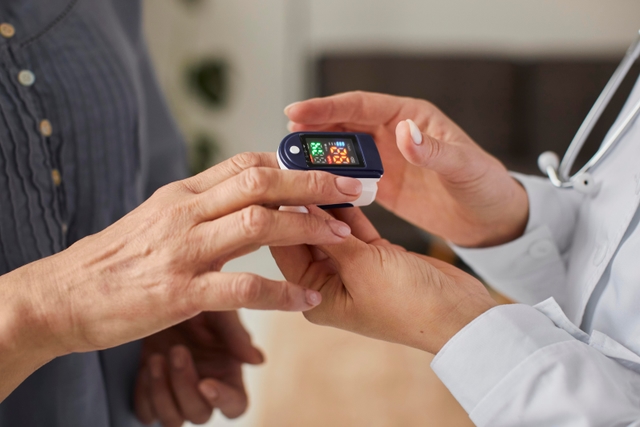
Oxygen Analysis — Oximeter
Oxygen comparison
Required Preparation
At 4810 m, with 56% oxygen available, perceived effort increases compared to sea level.
How to prepare
- Occasional training: specific preparation and progressive acclimatization are required before the summit.
- Regular training: plan acclimatization stops and monitor oxygen saturation.
- Endurance training: respect physiological adaptation times even if fitness level is high.
- Consider a sports medical assessment before the ascent.
Route and Trail
Peak Guide
The Roof of Europe. The unequaled glacial frontier that skims five thousand meters, magnetizing aspirations and instilling severe awe at 4810 meters. The normal track from the Goûter requires deep respect for the altitude, cold blood on bare ice, and thighs conditioned for relentless elevation gains.
Quick Facts
| Detail | Value |
|---|---|
| Altitude | 4810 m a.s.l. |
| Mountain group | Graian Alps, Mont Blanc Massif |
| Difficulty | PD (Slightly Difficult) via Goûter route |
| Total elevation gain | ~1344 m (from Refuge du Goûter, 3835 m) |
| Total distance | 12.6 km round-trip |
| Route development | 14.2 km (actual trail distance) |
| Ascent time | 4–6 hours from Refuge du Goûter |
| Recommended season | Mid-June – mid-September |
| Starting point | Les Houches or Saint-Gervais-les-Bains (France) |
| Key intermediate hut | Refuge du Goûter (3835 m) — mandatory overnight stop |
Oxygenation and Acclimatization
At 4810 meters you forcefully breach the biological barrier of high altitude to slide into the limbo of extreme elevations. With a barometric remnant equal to a miserable 56% of the oxygen breathable at sea level, acclimatization is not a whim; it is a clause negotiated with survival. More than one perfectly intact athletic alpinist has been struck down and forced to retreat two hundred meters from the summit due to AMS (Acute Mountain Sickness).
Begin breathing from your diaphragm the moment you step out of Refuge du Goûter, utilizing the so-called pressure breathing: blow obstinately against nearly closed lips to better conserve lung volume. The hypoxia will be crushing; you will hike between 70-75% SpO₂, feeling a pulsating throb everywhere. One rule above all: walk at an asphyxiated pace, never surge, and if you notice extreme shortness of breath, deep coughing, and staggering, swallow your pride and turn around to rapidly lose altitude.
The Ascent (Goûter Route)
Day 1: Engaging the scree and securing the Goûter The first taste of the realm is raw. Disembarking from the scenic trams (Nid d'Aigle), you mount the barren trail toward Tête Rousse. But the gate of mountaineering discord lies higher up: two or three jagged hours crossing the detrital expanse of the famous Couloir du Goûter. Amidst continuous rockfall, it must be forded rapidly with eyes gazing uphill, until you reach the eagle's nest of Refuge du Goûter (3835 m), where you will catch a miserable sleep caressed by the winds.
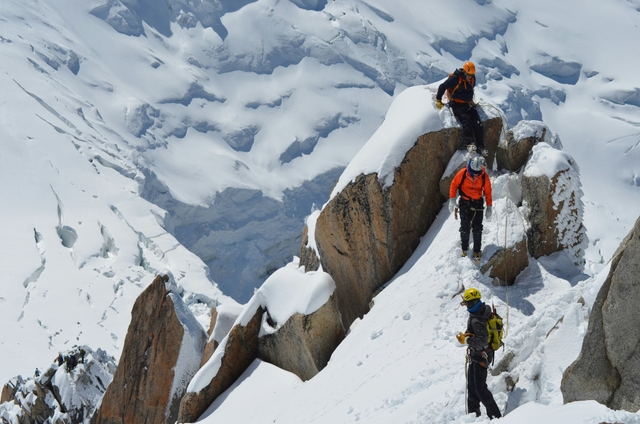
Day 2: Into the razor-sharp wind Departure in the bowels of the night, under the moon that enamels the immense Dôme du Goûter. The gradients swell toward the providential but freezing shelter of the Vallot Hut at 4362 meters. From this rocky outcrop onward, the music becomes pure vertigo. The aerial aesthetics of the Bosses du Dromadaire trace breathtaking exposed ridges over goosebump-inducing abysses, demanding calm to step securely with crampons on blown and hardened snow. And beyond the terminal fatigue, cradled on the most imperious cornices in Europe, you stand alone along the whitened spine of the absolute summit.
Physical Preparation
Tackling Mont Blanc requires confidence tested at at least 4000 meters on other classics like Gran Paradiso. You need resilient musculature capable of chewing through at least 1500 positive meters in the face of inhuman altitudes first, and mastery of ice axes to parry slips on dizzying ridges second.
| Starting level | Preparation time | Key Phases |
|---|---|---|
| Constant Hiker | 4-6 months | Progressive vertical loading. At least a couple of four-thousanders completed prior to Mont Blanc. |
| Average Alpinist | 4-8 weeks | Optimization of crampon footwork. Mandatory prolonged acclimatization on preparatory heights. |
At altitude, amidst freezing temperatures pushed dozens of degrees below zero, failure arrives punctually for those who overdraw their cardiovascular conditioning account.
Equipment
Either you organize yourself with a knife between your teeth to tolerate ruthless blizzards and violent physical assaults, or there is no point in bothering.
Essential:
- Suitable harness and uncompromised climbing helmet
- Sharp 12-point crampons on high-grade thermally insulated boots, and a versatile ice axe
- Ropes and ice screws (fundamental in crevasse rescues and if the terrain becomes encrusted)
Recommended:
- Goretex overpants and winter down jacket
- A vital liter-sized thermos and anti-freezing sugary gels for a quick caloric top-up
- Pocket pulse oximeter (for empirical evaluations) — use the free altitude oxygen calculator to preview SpO₂ values at each refuge before departure
Brief Historical Notes
Conquered under the wing of the frank Dr. Paccard and the indispensable mountain boldness of crystal hunter Jacques Balmat in the scorching August of 1786. An enterprise spurred and rewarded by the enlightened scientist de Saussure, which to all intents and purposes officially cut the starting ribbon for alpinism as we all, in our hearts, love it today.
Under Pressure: Europe's Overcrowded Roof
Every summer, more than 20,000 people attempt to reach the summit of Mont Blanc. During peak season — July and August — an estimated 300–400 climbers per day are on the Goûter Route alone. The result is inevitable: queues on the fixed ropes, refuges fully booked weeks in advance, and a glacial ecosystem under pressure no high-altitude environment can sustain indefinitely.
The Couloir du Goûter and multiplying risk. The Couloir is already one of the most dangerous passages in the Alps for natural rockfall — worsened by melting permafrost. Overcrowding adds a factor that did not exist fifty years ago: when dozens of climbers are in the couloir in succession, rocks dislodged by those above hit those below. The risk is not linear. It multiplies with the headcount.
The refuges as a litmus test. The mandatory booking system at the Refuge du Goûter (introduced by the FFCAM) is a direct response to overcrowding: no reservation, no access. At peak season, slots are gone within minutes of opening. Those without bookings go up anyway — sleeping outside, bivouacking on the route, or crossing the couloir at the wrong hours.
Waste and glacial impact. The massif's glaciers accumulate decades of mass alpinism. Meltwater carries organic and chemical residues downstream. As glaciers retreat, what was buried comes back to the surface. The footprint of past tourism becomes visible in the moraines, the crevasses, along the trails.
The daily cap question. The municipality of Chamonix, the Italian Alpine Club, and French authorities periodically discuss imposing a daily limit on access — partially implemented on the Italian side for certain routes. Resistance comes from the local mountaineering tourism industry. The question no one has yet answered clearly: how many people can this mountain hold?
The most honest answer for those heading up is also the simplest: go in the off-season, book well ahead, leave nothing behind. Mont Blanc is at its best when it is nearly empty — a September morning, a clear ridge, the world below and no one in the queue.
Access the complete guide for free
Enter your email and get immediate access + PDF download
What you need for Mont Blanc
Buying through these links supports Oxymeter at no extra cost to you — thank you! As an Amazon Associate, Oxymeter earns from qualifying purchases.
Indicative list. Adapt equipment to weather conditions and your experience level.
Has Oxymeter been useful to you?
Oxymeter is built by one person: servers, data and hours of work are all self-funded, and everything stays free with no ads. If you'd like to help, you can buy us a coffee.
Buy us a coffeeEven a small gesture makes a big difference. Thank you!
Open the page for up-to-date gear links: https://www.oxymeter.it/en/vetta/monte-bianco/
Sources and References
The information on this page has been verified from the following sources
Related peaks
Discover other peaks in the same area
Go deeper with our articles
Guides and tips to prepare yourself
Calculate your altitude sickness risk
7 questions — AMS risk estimate based on WMS guidelines