Ama Dablam
Khumbu, Solukhumbu, Nepal
Oxygen Analysis — Oximeter
Oxygen comparison
Required Preparation
At 6812 m, with 42% oxygen available, perceived effort increases compared to sea level.
How to prepare
- Occasional training: this altitude requires mountaineering experience and specific preparation.
- Regular training: plan multiple days of progressive acclimatization at intermediate altitudes.
- Endurance training: physical fitness alone does not replace acclimatization at these altitudes.
- Consult a mountain medicine specialist before departure.
Route and Trail
Peak Guide
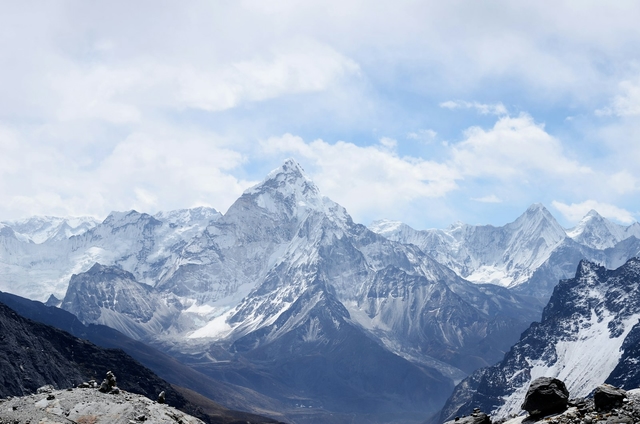
There's a mountain that steals every photograph in the Khumbu valley. It isn't Everest. It's Ama Dablam — 6812 metres of granite and ice rising like a blade above the trail to Everest Base Camp. People call it "the Matterhorn of the Himalaya," and for once the comparison isn't marketing: the pyramid is almost perfect, the ridges fall away steep on every side. The name, in Sherpa, means mother's necklace: the two long ridges are the arms of a mother (ama) protecting her child, and the hanging glacier below the summit is the dablam, the double-pendant charm box Sherpa women wear at the neck. On top, the air holds 42% of the oxygen available at sea level. Less than half of what you're breathing right now.
It isn't an 8000er. But don't let the altitude fool you. Ama Dablam is a genuine technical climb — rock, steep ice, a traverse across corniced ridges that rattles even veterans. And it's almost always climbed without bottled oxygen.
Technical Data
| Item | Value |
|---|---|
| Altitude | 6812 m (22,349 ft) |
| Range | Khumbu, Himalaya — Sagarmatha National Park, Nepal |
| Name meaning | "Mother's necklace" (Sherpa) |
| Difficulty | TD — Southwest Ridge: rock IV-V, steep ice, mixed |
| Elevation gain from Base Camp | 2212 m (BC 4600 m → Summit 6812 m) |
| Time from Camp 2.7 | 5–7h (C2.7 ~6300 m → Summit) |
| Full expedition | ~25–30 days (including approach trek) |
| Recommended season | October – November (post-monsoon) |
| Starting point | Base Camp (4600 m) |
| High camps | C1 (5650 m), C2 (6000 m), C2.7/C3 (~6300 m) |
| Supplemental oxygen | Rarely used |
| First ascent | 13 March 1961 — Mike Gill, Barry Bishop, Mike Ward, Wally Romanes (Hillary expedition) |
The Route (Normal Route — Southwest Ridge)
The approach is half the magic. You fly into Lukla, then walk for days up the Khumbu: Namche Bazaar, Tengboche with its monastery, finally Base Camp at 4600 m on a grassy meadow at the foot of the mountain. The trek earns its keep. Every slow day climbing toward BC is acclimatization in the bank.
Base Camp → Camp 1
4600 m → 5650 m | Gain: +1050 m | Time: 5–6h
You climb a long moraine and scree ridge. Strenuous hiking, nothing technical — but the gain is real and the air is already thin. Camp 1 sits on a panoramic saddle with a view of the whole route above.
Camp 1 → Camp 2
5650 m → 6000 m | Gain: +350 m | Time: 4–6h
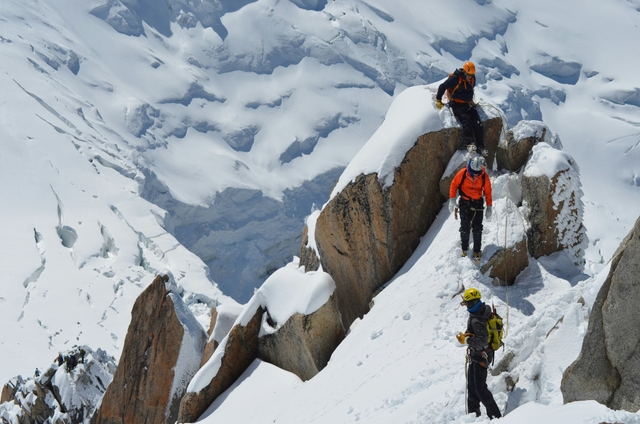
This is where the real climbing starts. The ridge turns rocky, exposed, fun. The crux is the Yellow Tower, a vertical slab of yellowish rock climbed on fixed ropes with jumars. Camp 2 is a tiny perch on the ridge — tents pitched over emptiness on both sides.
Camp 2 → Camp 2.7 (C3)
6000 m → ~6300 m | Gain: +300 m | Time: 3–5h
The most spectacular and demanding stretch. Sustained steep ice, mixed sections, and the famous Mushroom Ridge: a near-horizontal traverse across snow cornices glued to a knife-edge crest. You go one at a time. A thousand metres of nothing below. The high camp sits just under the Dablam, the great hanging serac whose collapse is the mountain's main objective hazard.
Camp 2.7 → Summit
~6300 m → 6812 m | Gain: +512 m | Time: 5–7h
Night start. You skirt the serac and grind up the final snow slopes — steep but less technical than the sections below. The summit is a small dome of snow. From there, Everest, Lhotse and Makalu look close enough to touch. Few panoramas on Earth repay this much effort.
Oxygen and Acclimatization
At 6812 m atmospheric pressure drops to around 425 hPa, a little over 40% of sea level. Every breath delivers 42% of the oxygen available at zero altitude. The body compensates: resting breathing rate climbs, the heart speeds up, the kidneys shift acid-base balance. In the first 48 hours at altitude, resting heart rate can rise 10-20 bpm.
Ama Dablam has an edge over the 8000ers: the long Khumbu approach builds natural acclimatization before you even touch rock. That's why most climbers reach the top without bottled oxygen. Summit SpO₂ in well-acclimatized people typically falls to 65-75%. Not the Death Zone — but enough to slow your mind and reflexes exactly where you need them sharpest.
The standard protocol runs 2-3 rotations between Base Camp and the high camps before the summit push, on the same old principle: climb high, sleep low. A mild headache the first night at a new camp is normal. A headache that worsens, nausea, loss of coordination — not normal. At these heights, ataxia and confusion mean one thing: descend, now.
Medical note: This information is for general guidance and does not replace consultation with a high-altitude medicine specialist.
Preparation
Ama Dablam doesn't forgive technical improvisation. You need to climb rock to grade IV-V, move on steep ice, work jumars on fixed lines while the void tugs at your crampons. This is no "first 6000er." It's a mountain for the complete alpinist.
Prerequisites: mixed-climbing experience, comfort on fixed ropes, at least one prior ascent above 5000-5500 m. Fitness matters, but headspace matters more: the Mushroom Ridge tests nerves, not lungs.
Essential gear:
- Harness, jumar, two safety lanyards with carabiners
- 12-point technical crampons and ice axe
- High-altitude boots (double or triple for nights at the high camps)
- Down suit or expedition parka for temperatures to −25/−30°C
- Helmet — rockfall on the ridge is real
- Category 4 glasses and high-SPF sunscreen
Season: October and November, after the monsoon, give the most stable windows. Clear skies, manageable wind, settled snow. Spring (April–May) is the second choice, usually colder and windier.
Cost: a guided commercial expedition runs roughly 6,000 to 12,000 USD, including permit, trek, equipped base camp and Sherpa support for fixing the ropes.
Frequently Asked Questions
How much oxygen is there on the summit of Ama Dablam?
On top of Ama Dablam, at 6812 m, the available oxygen is 42% of sea level. Barometric pressure drops to about 425 hPa, against 1013 hPa at zero altitude. Every breath delivers less than half the oxygen you'd inhale at sea level. Most climbers tackle the summit without supplemental oxygen.
Is Ama Dablam harder than Everest?
Technically, on many sections, yes. Everest by the normal route is higher and more dangerous because of extreme altitude, but the climbing is less sustained. Ama Dablam demands real rock and ice technique for nearly the whole ascent: the Yellow Tower and the Mushroom Ridge have no equivalent on Everest. It's a mountain you climb, not one you slog up.
Do you need supplemental oxygen on Ama Dablam?
No, in the vast majority of cases. At 6812 m the altitude is demanding but below the 8000er threshold, and the long approach trek builds solid acclimatization. Well-prepared climbers summit on their own lungs, with SpO₂ typically between 65 and 75%.
What's the best season to climb Ama Dablam?
October and November are the best months: the post-monsoon brings stable weather, clear skies and reliable summit windows. Spring (April–May) is possible but generally colder and windier.
Who first climbed Ama Dablam?
On 13 March 1961, Mike Gill (New Zealand), Barry Bishop (USA), Mike Ward (UK) and Wally Romanes (New Zealand) reached the summit via the Southwest Ridge. They were part of an expedition linked to Sir Edmund Hillary, then running high-altitude physiology studies at the nearby Silver Hut.
Access the complete guide for free
Enter your email and get immediate access + PDF download
What you need for Ama Dablam
Buying through these links supports Oxymeter at no extra cost to you — thank you! As an Amazon Associate, Oxymeter earns from qualifying purchases.
Indicative list. Adapt equipment to weather conditions and your experience level.
Has Oxymeter been useful to you?
Oxymeter is built by one person: servers, data and hours of work are all self-funded, and everything stays free with no ads. If you'd like to help, you can buy us a coffee.
Buy us a coffeeEven a small gesture makes a big difference. Thank you!
Open the page for up-to-date gear links: https://www.oxymeter.it/en/vetta/ama-dablam/
Sources and References
The information on this page has been verified from the following sources
Related peaks
Discover other peaks in the same area
Go deeper with our articles
Guides and tips to prepare yourself
Calculate your altitude sickness risk
7 questions — AMS risk estimate based on WMS guidelines