Cho Oyu
Himalayas, Nepal/Tibet (China)
Oxygen Analysis — Oximeter
Oxygen comparison
Required Preparation
At 8188 m, with 34% oxygen available, perceived effort increases compared to sea level.
How to prepare
- Occasional training: this altitude requires mountaineering experience and specific preparation.
- Regular training: plan multiple days of progressive acclimatization at intermediate altitudes.
- Endurance training: physical fitness alone does not replace acclimatization at these altitudes.
- Consult a mountain medicine specialist before departure.
Route and Trail
Peak Guide
October 19, 1954. Herbert Tichy, Sepp Jöchler, and sirdar Pasang Dawa Lama reached the summit of Cho Oyu — 8,188 meters, the sixth-highest mountain on Earth — without supplemental oxygen. It was a lightweight Austrian expedition. They pulled it off. Cho Oyu became the fifth 8,000-meter peak ever climbed, just four years after Annapurna's first ascent and sixteen months after Everest. At the summit, the air holds 34% of the oxygen available at sea level. Every breath delivers roughly a third of what you're breathing right now.
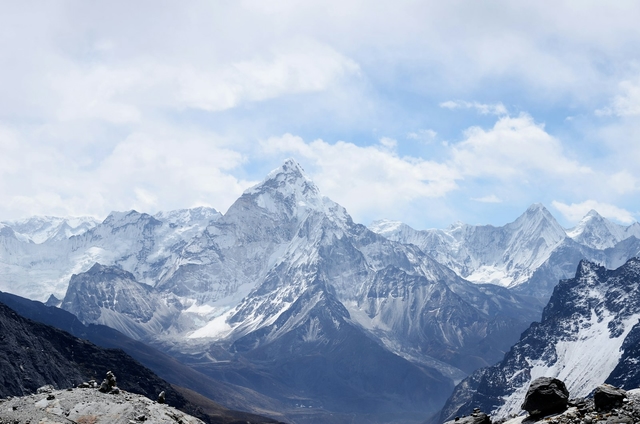
Cho Oyu sits on the Nepal–Tibet (China) border, 20 km west of Everest. The name translates from Tibetan as Turquoise Goddess. It's called the world's most accessible 8,000-meter peak — not because it's easy, but because its standard route up the Northwest Ridge from the Tibetan side offers relatively moderate terrain by 8,000-meter standards. Many climbers use it as their first foray into the death zone. A gateway peak, they say. Still: 188 meters of that route sits above 8,000 meters. No gateway is quite like that.
Technical Overview
| Data | Value |
|---|---|
| Altitude | 8,188 m (26,864 ft) |
| Massif | Himalayas, Nepal/Tibet (China) border |
| Name meaning | "Turquoise Goddess" (Tibetan) |
| Difficulty | PD+ / D- — normal route on snow/ice with rocky section |
| Elevation gain from Base Camp | 3,388 m (BC 4,800 m → Summit) |
| Elevation gain from ABC | 2,538 m (ABC 5,650 m → Summit) |
| Time from Camp III | 5–8h (C3 7,400 m → Summit) |
| Full expedition | ~40–50 days |
| Best season | September – October (post-monsoon) |
| Starting point | Chinese Base Camp (4,800 m) |
| High camps | ABC (5,650 m), C1 (6,400 m), C2 (7,100 m), C3 (7,400 m) |
| First ascent | October 19, 1954 — Tichy, Jöchler, Pasang Dawa Lama (Austria) |
Route (Normal Route — Northwest Ridge, Tibet side)
Cho Oyu is climbed almost exclusively from the Tibetan side. The Nepali side exists but is far more technical and rarely attempted. Standard logistics run from Kathmandu through the Tibetan border crossing, reaching Base Camp by 4WD Landcruiser.
Chinese Base Camp → Advanced Base Camp (ABC)
4,800 m → 5,650 m | Gain: +850 m | Time: 4–6h
From BC, the road continues partially by jeep to about 5,300 m, then you walk across moraines. Most of the approach is on non-glacial terrain. ABC sits on a wide, sunny moraine — this is where teams spend most of their time, not at Chinese BC. It's comfortable by Himalayan standards, with space for full expedition infrastructure.
ABC → Camp I
5,650 m → 6,400 m | Gain: +750 m | Time: 4–6h
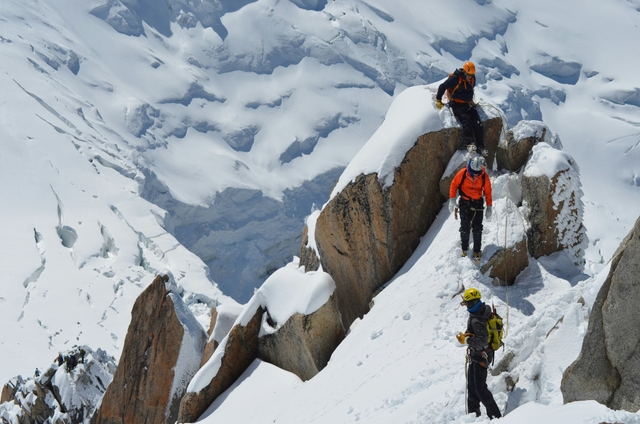
From ABC, cross the moraine to the glacier. The technical crux of this section is a 20–30 meter ice cliff on fixed ropes (roughly 55–65°). Above it, a protected glacial bowl holds Camp I. Fixed ropes are placed by rope-fixing teams at the start of each season and the exact line shifts year to year.
Camp I → Camp II
6,400 m → 7,100 m | Gain: +700 m | Time: 4–6h
Mixed snow and rock on slopes of 25–40°. Less exposed than the lower section, but you're already in the critical altitude zone. Acclimatization rotations to Camp II and back to ABC are standard before the summit push. Most teams don't sleep here during rotations — only on the final climb.
Camp II → Camp III
7,100 m → 7,400 m | Gain: +300 m | Time: 2–3h
Short section, but you're at the lower margin of the death zone. Most commercial expeditions use supplemental oxygen for sleeping at Camp III. Some strong independent teams skip Camp III and go direct from Camp II to the summit — it's possible, not recommended as the default.
Camp III → Summit
7,400 m → 8,188 m | Gain: +788 m | Time: 5–8h
You leave between midnight and 2 AM. The route's technical crux comes first: a rocky step of 20–30 meters at around 7,500–7,600 m, mixed rock and ice. Get that behind you and the slopes open up — 30–40° snow all the way to the summit plateau. The pace is brutal. Fifty steps, stop. Forty steps, stop. Cho Oyu's summit is a wide plateau. You don't reach a sharp point; you traverse to the far end where the true highpoint is. Views of Everest, Lhotse, Makalu. Nobody lingers long.
Oxygen and Acclimatization
At 8,188 m, atmospheric pressure drops to roughly 356 hPa — about 35% of sea level. The oxygen fraction stays constant at 20.9%, but the absolute number of molecules per breath collapses. Each inhale brings your lungs 34% of the oxygen available at sea level. The body responds by increasing breathing and heart rate, ramping up red blood cell production over weeks, and shedding non-essential cognitive load.
The Death Zone begins at 8,000 m. Cho Oyu enters it for 188 vertical meters. That sounds limited. It isn't: above 8,000 m, physiological deterioration is continuous and only reversible by descending. Typical summit SpO₂ with supplemental oxygen is 55–70%. Without supplemental oxygen it drops further — the 1954 first ascent proves it's survivable, but it remains the exception.
Standard acclimatization protocol:
- BC (4,800 m) → ABC (5,650 m): 1–2 rest days
- Rotation ABC → C1 (6,400 m) → back to ABC
- Rotation ABC → C2 (7,100 m) → back to ABC
- Rest at ABC (5–7 days)
- Summit push: ABC → C1 → C2 → C3 → Summit → C2 → ABC
Walk high, sleep low. That rule doesn't change at 8,000 meters. Acclimatization rotations build adaptation; descents enable recovery. There's no shortcut — the physiological plateau is built with time, not willpower.
Severe AMS symptoms above 6,000 m — persistent headache, vomiting, ataxia, confusion — are an emergency. Descend immediately. Don't wait for morning.
Medical note: This information is educational only and does not substitute consultation with a high-altitude medicine specialist.
Preparation
Cho Oyu is the most accessible 8,000-meter peak. "Accessible" is still relative. You need real high-altitude experience before you go — at least one serious 7,000-meter peak, preferably with nights above 6,500 m. The physics don't care about your intentions: the gap between 7,000 and 8,000 meters isn't linear.
Minimum prerequisites: autonomous movement on a crevassed glacier, fixed-rope climbing on steep ice (jumar technique), nights above 6,000 m. At least one Aconcagua season or a Himalayan seven-thousander is considered minimum preparation.
Physically: VO₂max ≥ 60 ml/kg/min. Multi-day outings with a 15–20 kg pack, ice climbing technique, and a solid aerobic base for long efforts at altitude.
Essential gear:
- Oxygen mask and regulator (Poisk system or equivalent)
- Oxygen bottles (2–4 cylinders, 4–6L, for summit push)
- High-altitude expedition suit rated to −40°C
- Double boots for high altitude
- 12-point technical crampons, stiff frame
- Ice axe, jumar, harness
- VHF radio
Season: September–October is primary. Post-monsoon stability offers more predictable weather windows than spring. October is statistically the strongest summit month.
Cost: A guided commercial expedition runs $15,000–$35,000 USD, including government permits (Nepal + Tibet), approach logistics, BC cook, oxygen, and high-altitude support.
Frequently Asked Questions
How much oxygen is there at the summit of Cho Oyu?
At Cho Oyu's summit (8,188 m), available oxygen is 34% of sea level. Atmospheric pressure drops to roughly 356 hPa (versus 1,013 hPa at sea level). Each breath brings less than a third of the oxygen you'd inhale at sea level. The vast majority of climbers use supplemental oxygen above 7,000 m.
Can you climb Cho Oyu without supplemental oxygen?
Yes — the 1954 first ascent was completed without supplemental oxygen by Tichy, Jöchler, and Pasang Dawa Lama. Some experienced alpinists still do it without today. It's the exception, not the rule: without supplemental oxygen, summit SpO₂ typically drops below 60%, with significant risk of cognitive impairment and acute mountain sickness.
What's the best time to climb Cho Oyu?
September–October is the main season. Post-monsoon weather brings stable, predictable conditions with less wind than spring. October is statistically the best month for summit attempts. Spring (April–May) is possible but less common, with more volatile weather patterns.
How long does a Cho Oyu expedition take?
A standard expedition takes 40–50 days: approach via Tibet (5–7 days), acclimatization rotations (20–30 days), summit window (5–10 days), descent and return. Some outfitters offer 28–30 day expeditions using pre-trip hypoxic acclimatization (altitude tents) before departure.
Is Cho Oyu really the easiest 8,000-meter peak?
It's considered the most accessible, not the easiest in absolute terms. The normal route is predominantly snow and ice with moderate slopes and limited objective hazard compared to other 8,000-meter peaks. That said: it enters the death zone, it has a technical rocky step at 7,500 m, and Tibetan weather can turn fast. The "easiest 8,000er" label has a cost — it attracts underprepared climbers. Don't let the label mislead you.
Access the complete guide for free
Enter your email and get immediate access + PDF download
What you need for Cho Oyu
Buying through these links supports Oxymeter at no extra cost to you — thank you! As an Amazon Associate, Oxymeter earns from qualifying purchases.
Indicative list. Adapt equipment to weather conditions and your experience level.
Has Oxymeter been useful to you?
Oxymeter is built by one person: servers, data and hours of work are all self-funded, and everything stays free with no ads. If you'd like to help, you can buy us a coffee.
Buy us a coffeeEven a small gesture makes a big difference. Thank you!
Open the page for up-to-date gear links: https://www.oxymeter.it/en/vetta/cho-oyu/
Sources and References
The information on this page has been verified from the following sources
Related peaks
Discover other peaks in the same area
Go deeper with our articles
Guides and tips to prepare yourself
Calculate your altitude sickness risk
7 questions — AMS risk estimate based on WMS guidelines