Monte Civetta
Dolomites, Province of Belluno, Veneto, Italy
Oxygen Analysis — Oximeter
Oxygenation along the route
Oxygen comparison
Required Preparation
At 3220 m, with 67% oxygen available, perceived effort increases compared to sea level.
How to prepare
- Occasional training: plan gradual acclimatization — resting heart rate will rise at this altitude.
- Regular training: keep a steady pace and watch for mild hypoxia symptoms.
- Endurance training: altitude is manageable with planning — avoid forcing the pace in the first hours.
Route and Trail
Peak Guide
Monte Civetta rises to 3220 meters above the Zoldo valley and Lake Alleghe, and its north-west face — a thousand meters of sheer rock — is one of the most recognizable profiles in the Dolomites. This is where Emil Solleder opened, in 1925, what many consider the first sixth-grade route in climbing history. The summit itself was reached far earlier, in 1855: probably the first major Dolomite peak ever climbed. At 3220 meters the air holds 67% of the oxygen you'd breathe at sea level. That number alone won't stop you. But the normal route is long, exposed, and almost entirely cabled. This isn't a hike. It's mountaineering.
Technical Sheet
| Data | Value |
|---|---|
| Altitude | 3220 m a.s.l. |
| Location | Dolomites, Province of Belluno, Veneto, Italy |
| Difficulty | Cabled normal route (via ferrata) — ~22 cable sections, up to grade C, very exposed |
| Available oxygen | 67% of sea level |
| Elevation gain | ~1713 m (net, Palafavera to summit) |
| Ascent time | 7–8h from Palafavera |
| Best season | July – mid-September |
| Starting point | Palafavera (1507 m) |
| Mountain huts | Coldai (2132 m), Torrani (2984 m) |
Route
The classic line starts at Palafavera (1507m), on the Passo Staulanza road. You walk the dirt track (trail 564) toward Malga Pioda, then pick up trail 556 to Rifugio Coldai Sonino (2132m) — about two hours. The Coldai sits on the Alta Via 1 and gets busy. If you want to sleep there, book well ahead.
From the hut the Sentiero Tivan (557) runs almost level along the mountain's east flank. It's a long, gorgeous traverse with Monte Pelmo in view the whole way. Don't be fooled, though — "level" doesn't mean "easy." There are already a few cables on the passages, you cross the Zoliere towers and the Porta del Masarè (2420m), and after hours of walking your net elevation gain is almost nothing. That's the nature of this approach. You walk a lot and climb little.
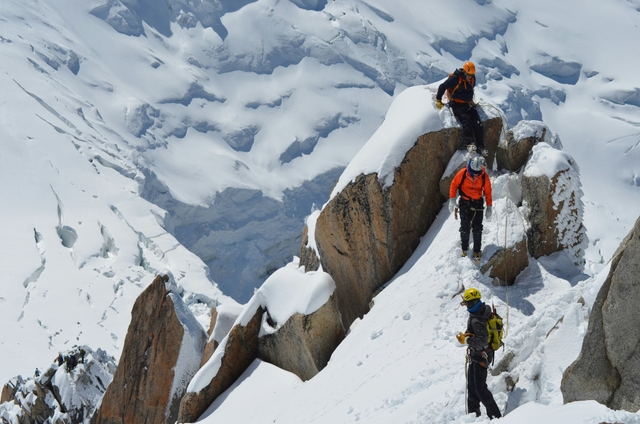
The real ferrata starts at the foot of a scree slope, around 2221m below Crepa Bassa. From here on, the kit goes on and stays on. The cables are numbered — 22 of them, a few hundred meters in total. Some pitches are seriously exposed; others are simple rock steps for hands and feet. You pass the Passo del Tenente (Grunwald) cable, roughly 25 meters long, enter a rocky gully, tackle a short four-meter chimney. Then the last 300 meters of gentle scree lead to Rifugio Torrani (2984m) — tiny, a single room, twelve beds. Beyond the Torrani, a few more cables and about forty minutes of ridge bring you to the summit cross.
The view, weather permitting, pays for everything: the void over the Alleghe valley to the west, more than two kilometers below, and Lake Coldai.
⚠️ Warning: every normal route on Civetta is a ferrata. A full ferrata set, helmet and harness are not optional. The climb demands experience on exposed cabled terrain and a full day of stable weather. Always check conditions with Rifugio Coldai and Torrani, or with CAI Veneto, before you set out.
Oxygen and Acclimatization
At 3220m the partial pressure of oxygen is 67% of sea level. For a healthy person, that altitude alone causes no serious trouble. The real issue is different: Civetta is a sustained effort. Seven or eight hours of walking and climbing, most of it above 2000 meters, with a ferrata kit slowing you down. At 67% oxygen, recovery between moves comes slower than you'd expect. You feel it most on the steep cables — your breath returns gradually, not at once.
Climbers who sleep at the Coldai or the Torrani reach the top partly adapted, and it helps. Do it in a single push from the valley and you'll feel the altitude in the final stretch: heavy legs, short breath.
AMS symptoms are rare here. A mild headache or some nausea may show up in the last few hundred meters, usually managed with hydration and a slow pace. Resting heart rate can climb 10-15 bpm in the first hours at altitude. That's normal.
A healthy, adapted person reads a typical summit SpO₂ between 89% and 93%. Values below 85% with a persistent headache, nausea or confusion mean you go down.
Drink before you're thirsty. Up high, thirst arrives late, and dehydration makes everything worse.
⚠️ Consider descending if you get: a headache that won't clear with rest and water, nausea or vomiting, loss of coordination, breathlessness at rest.
This advice is informational and does not replace medical guidance. With serious symptoms at altitude, descend at once and seek help.
Preparation
Civetta is not a first ferrata. The approach alone is demanding — four hours or more to the first cable — and the cabled route is long, exposed, with passages up to grade C. Asked by a beginner where to start, a local guide answered flatly: start somewhere else. First time with a ferrata kit? Go shorter and better protected.
Who this climb suits:
- Solid experience on medium-to-hard ferratas and exposed alpine terrain
- Good aerobic endurance: the day runs 7 to 8 hours up, plus the descent
- No disabling fear of heights — there are exposed traverses with and without cable
Essential gear: certified ferrata set (harness plus Y-lanyard with energy absorber), alpine helmet, stiff-soled boots, gloves for the cables, waterproof layers (Zoldo weather flips fast).
Water: there are no streams on the route. Carry at least 2 liters, or refill at the two huts. A water source sits at the Palafavera parking.
Season: July to mid-September, when Coldai and Torrani are open and the rock is snow-free. Start early — 5 a.m. isn't excessive — to beat the afternoon storms.
Frequently Asked Questions
How much oxygen do you breathe on Civetta's summit?
At 3220m available oxygen is 67% of sea level, with atmospheric pressure around 684 hPa against 1013 at the coast. For a healthy person it's no barrier on its own, but the perceived effort on the long cabled route, pack on your back, runs well above a comparable climb at low elevation.
Is Civetta's normal route suitable for beginners?
No. Every normal route is a ferrata, and this one has about 22 cable sections with passages up to grade C on very exposed terrain. You need solid experience on medium-to-hard ferratas. Newcomers should train first on shorter, better-protected routes, as local guides advise.
How long is the climb and where does it start?
From the Palafavera area, count on 7-8 hours to the summit: about 2 hours to Rifugio Coldai, another 2 on the Sentiero Tivan to the ferrata start, then 3h30 on the cabled route. Add the descent, which follows the same line. Many split the climb by sleeping at the Coldai or the Torrani.
Is there a risk of altitude sickness (AMS) on Civetta?
The risk is low. At 3220m serious symptoms are rare in healthy people, especially with a night in a hut. A mild headache or excess fatigue may appear in the final section; manage it with hydration and a slow pace. If symptoms worsen, descend.
Do I need a helmet and ferrata set?
Yes, mandatory. The route is cabled along most of its length and crosses rockfall-prone zones. A full ferrata set with energy absorber, helmet and harness are essential — without them, don't attempt it.
Sources and References
- Mountains For Everybody — Climbing Monte Civetta — first-hand normal-route report, cables, huts
- Itinerari Trekking — Cima Civetta 3220m (Via Normale) — route description, timings, approach from Palafavera and Pecol
- Peakbagger — Monte Civetta — elevation, prominence, coordinates
- CAI Veneto — Rifugio Torrani — summit hut data and opening
- ICAO Standard Atmosphere (Doc 7488/3) — formula for pressure and oxygen at altitude
- UIAA Mountain Medicine — AMS/HACE/HAPE guidelines
Access the complete guide for free
Enter your email and get immediate access + PDF download
What you need for Monte Civetta
Buying through these links supports Oxymeter at no extra cost to you — thank you! As an Amazon Associate, Oxymeter earns from qualifying purchases.
Indicative list. Adapt equipment to weather conditions and your experience level.
Has Oxymeter been useful to you?
Oxymeter is built by one person: servers, data and hours of work are all self-funded, and everything stays free with no ads. If you'd like to help, you can buy us a coffee.
Buy us a coffeeEven a small gesture makes a big difference. Thank you!
Open the page for up-to-date gear links: https://www.oxymeter.it/en/vetta/civetta/
Sources and References
The information on this page has been verified from the following sources
Related peaks
Discover other peaks in the same area
Go deeper with our articles
Guides and tips to prepare yourself
Calculate your altitude sickness risk
7 questions — AMS risk estimate based on WMS guidelines