Island Peak (Imja Tse)
Solukhumbu, Sagarmatha National Park, Nepal
Oxygen Analysis — Oximeter
Oxygen comparison
Required Preparation
At 6189 m, with 45% oxygen available, perceived effort increases compared to sea level.
How to prepare
- Occasional training: this altitude requires mountaineering experience and specific preparation.
- Regular training: plan multiple days of progressive acclimatization at intermediate altitudes.
- Endurance training: physical fitness alone does not replace acclimatization at these altitudes.
- Consult a mountain medicine specialist before departure.
Route and Trail
Peak Guide
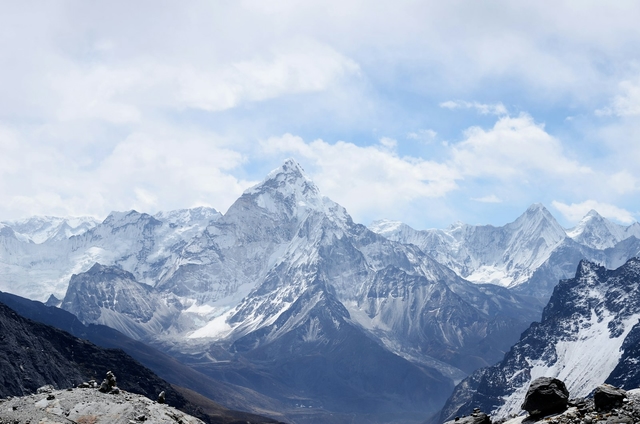
From the village of Dingboche, at 4410 metres, Island Peak rises from the glaciers like an island in a frozen sea. The name came from Eric Shipton in 1953 — he was in Nepal to scout what would become the first ascent of Everest, and part of the team climbed here for training. On top, at 6189 metres, the available oxygen is 45% of what you're breathing right now. It's a technical climb, not a walk — but it's also the entry point that hundreds of alpinists choose every year to understand what it truly means to stand above 6000 metres.
The official name is Imja Tse, given in 1983 by the Nepal Mountaineering Association. In the field, nobody uses it. It's Island Peak.
Technical Data
| Item | Value |
|---|---|
| Altitude | 6189 m (20,305 ft) |
| Official name | Imja Tse |
| Range | Himalaya — Solukhumbu, Sagarmatha National Park, Nepal |
| Difficulty | AD− — glacier, fixed-rope ice headwall |
| Elevation gain from Base Camp | 1102 m (BC 5087 m → Summit 6189 m) |
| Ascent time | 6–9h (Base Camp → Summit) |
| Starting point | Pareshaya Gyab / Base Camp (5087 m) |
| High camp (optional) | ~5600 m |
| Oxygen at summit | 45% of sea level |
| Typical summit SpO₂ | 72–80% (acclimatized climbers) |
| Permit required | Yes — Nepal Mountaineering Association |
| First ascent (SW summit) | 1953 — Tenzing Norgay, Charles Evans, Alfred Gregory, Charles Wylie + 7 Sherpas |
| First ascent (main summit) | 1956 — Hans-Rudolf Von Gunten + 2 Sherpas (Swiss expedition) |
The Route (Normal Route — from Base Camp)
The approach isn't a formality. You fly into Lukla (2860 m) and walk up the Khumbu valley for 8–10 days to Chhukung (4730 m). Every day on the trail is acclimatization: Namche Bazaar, Tengboche, Dingboche, Chhukung — altitude rising gradually, your body adapting before the technical climbing even begins.
Chhukung → Base Camp
4730 m → 5087 m | Gain: +357 m | Time: 3–4h
From the village you head south through moraines and glacial lakes. Nothing technical — but the ground is rough and the air already thin. Base Camp (Pareshaya Gyab) sits on a flat rocky platform at the mountain's foot. Standard plan: arrive in the afternoon, rest, leave at 2 a.m.
Base Camp → Crampon Point
5087 m → ~5700 m | Gain: +613 m | Time: 3–4h
You start between 2 and 3 a.m. The first 600 metres are moraine and scree, then firm snow. At the Crampon Point you put on crampons — from here it's ice. Teams using the High Camp (~5600 m) shorten this stretch to the technical section alone.
Crampon Point → Headwall → Summit
~5700 m → 6189 m | Gain: +489 m | Time: 3–5h
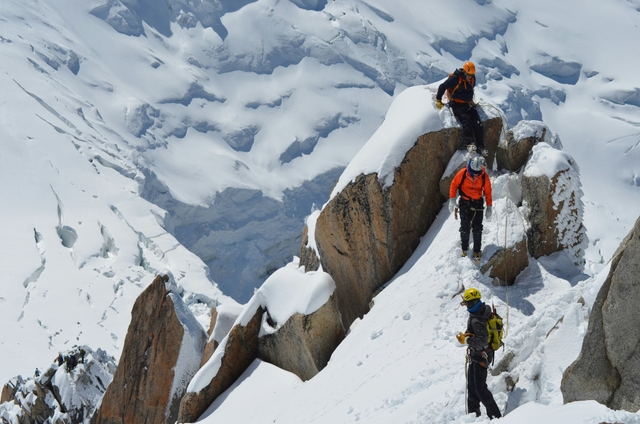
This is where it gets serious. You climb the glacier on fixed ropes to the Headwall — nearly 100 metres of ice at up to 60 degrees. Jumars go on. At the top of the headwall there's a deep crevasse; since 2009 a fixed aluminium ladder crosses it. On the summit ridge the view opens to Everest, 10 km north — half-blocked by the wall of Lhotse, towering 2300 m above you.
Route note: the High Camp option at ~5600 m reduces summit-day elevation gain. Worth considering based on individual acclimatization and guide logistics.
Oxygen and Acclimatization
At 6189 m atmospheric pressure drops to around 465 hPa — just over 45% of sea level. Every breath delivers 45% of the oxygen you'd get at zero altitude. It's not the Death Zone of the 8000ers. But it's enough to make everything slow down: thoughts, movements, decisions.
The good news: Island Peak is almost always climbed without supplemental oxygen. Well-acclimatized climbers — after 10–14 days of gradual trekking through the Khumbu — typically record summit SpO₂ of 72–80%. Not a great number on paper. In the field, with solid acclimatization, it's enough to ascend, think clearly, and descend safely.
The main risk isn't the altitude itself. It's insufficient acclimatization. Resting heart rate can rise 10–20 bpm in the first 48 hours at a new altitude — normal. What isn't normal: a headache that worsens, nausea, loss of coordination. At this height, ataxia and confusion mean one thing. Descend. Now.
Medical note: This information is for general guidance and does not replace consultation with a high-altitude medicine specialist.
Preparation
Island Peak isn't extreme technical terrain. It isn't a hike either. You need to walk on ice with crampons, use an ice axe, handle jumars on fixed rope. Most accidents happen on the headwall or at the crevasse crossing — preventable with basic technique and the right guide.
Prerequisites: strong aerobic fitness (you'll walk for weeks at altitude), ability to use crampons and ice axe, no free-climbing requirement. A local guide is mandatory under NMA regulations and essential for safety on the headwall.
Essential gear:
- 12-point crampons and technical ice axe
- Harness, jumar, two safety lanyards with carabiners
- High-altitude mountaineering boots (double boots for insulation)
- Heavy down jacket or expedition parka (summit temperatures to −15/−20°C)
- Glacier goggles (category 4) and high-SPF sunscreen
- Quality headlamp with spare batteries (mandatory night start)
Season: spring (March–May) and autumn (October–November). Summer is out — the monsoon makes conditions dangerous. October is the most popular month: stable weather, excellent visibility, settled snow.
Permit: the Nepal Mountaineering Association requires a specific permit for Imja Tse, currently in the range of 125–250 USD per person depending on season.
Frequently Asked Questions
How much oxygen is there on the summit of Island Peak?
On the summit of Island Peak / Imja Tse, at 6189 m, the available oxygen is 45% of sea level. Barometric pressure drops to around 465 hPa against 1013 hPa at zero altitude. Every breath delivers less than half the oxygen you'd inhale at sea level. Nearly all climbers reach the summit without supplemental oxygen.
Is Island Peak suitable for beginners in mountaineering?
It depends on experience. It's Nepal's most accessible technical peak — but accessible doesn't mean risk-free. You need to handle crampons and ice axe, manage jumars on fixed rope, and be properly acclimatized. Never worn crampons? You're not ready. Done high-altitude trekking and want your first real ice climb? You're in the right place.
How long does it take to climb Island Peak?
A complete itinerary from Kathmandu runs 17–22 days: 8–10 days of approach trekking from Lukla (for acclimatization), 2–3 days at Base Camp, summit day (6–9h up from BC), then descent to Lukla for the flight out. This isn't a quick trip — it's a serious undertaking that demands real planning.
Can you climb Island Peak after Everest Base Camp?
Yes — and this combination is one of the most popular in the region. The EBC trek passes through Dingboche and Chhukung, both close to Island Peak Base Camp. The acclimatization built to reach EBC (5364 m) is near-perfect preparation: your body is already adapted to altitude, your lungs know how to work in thin air.
Do you need a guide to climb Island Peak?
Yes. The Nepal Mountaineering Association requires you to climb with a certified guide. Beyond the legal requirement, it's essential for safety: the headwall and crevasse crossing involve fixed-rope management that an experienced guide sets up and supervises.
What's the difference between Island Peak and Mera Peak?
Both are trekking peaks in the Khumbu, but with different characters. Mera Peak (6476 m) is higher, with fewer technical demands — mostly wide glacier slopes at moderate angles. Island Peak is lower but more technical, with a headwall requiring jumars and fixed ropes. Mera Peak suits those who want to go high with less technique; Island Peak suits those who want a genuine introduction to ice climbing.
Access the complete guide for free
Enter your email and get immediate access + PDF download
What you need for Island Peak (Imja Tse)
Buying through these links supports Oxymeter at no extra cost to you — thank you! As an Amazon Associate, Oxymeter earns from qualifying purchases.
Indicative list. Adapt equipment to weather conditions and your experience level.
Has Oxymeter been useful to you?
Oxymeter is built by one person: servers, data and hours of work are all self-funded, and everything stays free with no ads. If you'd like to help, you can buy us a coffee.
Buy us a coffeeEven a small gesture makes a big difference. Thank you!
Open the page for up-to-date gear links: https://www.oxymeter.it/en/vetta/island-peak/
Sources and References
The information on this page has been verified from the following sources
Related peaks
Discover other peaks in the same area
Go deeper with our articles
Guides and tips to prepare yourself
Calculate your altitude sickness risk
7 questions — AMS risk estimate based on WMS guidelines