Manaslu
Gorkha, Nepal
Oxygen Analysis — Oximeter
Oxygen comparison
Required Preparation
At 8163 m, with 34% oxygen available, perceived effort increases compared to sea level.
How to prepare
- Occasional training: this altitude requires mountaineering experience and specific preparation.
- Regular training: plan multiple days of progressive acclimatization at intermediate altitudes.
- Endurance training: physical fitness alone does not replace acclimatization at these altitudes.
- Consult a mountain medicine specialist before departure.
Route and Trail
Peak Guide
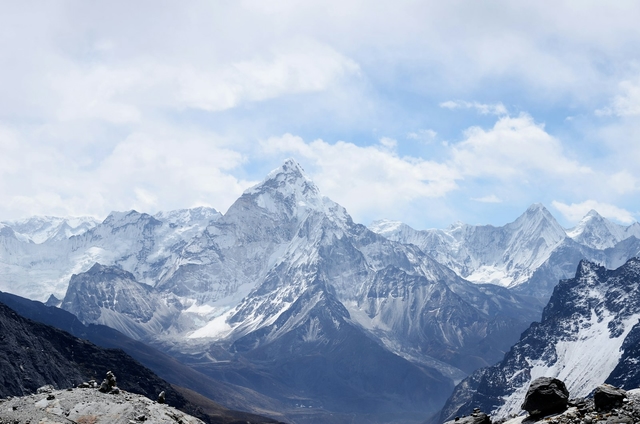
The world's eighth-highest mountain. Manaslu rises to 8163 metres in Nepal's Gorkha District, its name derived from the Sanskrit manasa — soul, intellect, spirit. A fitting name. At this altitude, every breath delivers just 34% of the oxygen you'd get at sea level. Your body works, but barely — and above 8000 metres, the Death Zone begins. You don't acclimatize there. You deteriorate. The objective is simple: reach the summit and get back down before the deterioration becomes irreversible.
The mountain was first climbed on 9 May 1956 by the Japanese expedition led by Yūichirō Maki. Toshio Imanishi and Gyalzen Norbu Sherpa reached the summit after six consecutive Japanese expeditions had failed. Six attempts. That persistence tells you something. Manaslu is often described as one of the more "accessible" eight-thousanders — and technically, that's true compared to K2 or Annapurna. It's still one of the most dangerous mountains on Earth.
Technical Details
| Detail | Value |
|---|---|
| Altitude | 8163 m a.s.l. |
| Range | Mansiri Himal, Nepalese Himalaya |
| Names | Manaslu, Kutang I |
| Rank | 8th highest mountain in the world |
| Difficulty | PD+ — extreme mountaineering on snow, ice and mixed terrain |
| Elevation gain from BC | 3363 m (Base Camp 4800 m → Summit 8163 m) |
| Estimated round-trip distance | ~10 km (normal route, NE face) |
| Time from Camp IV | 6–10h (C4 → Summit) |
| Full expedition | ~45–55 days (including acclimatization rotations) |
| Best season | April–May / September–October |
| Starting point | Manaslu Base Camp (4800 m) — approach from Samagaon (3530 m) |
| High camps | C1 (5700 m), C2 (6400 m), C3 (6800 m), C4 (7500 m) |
| First ascent | 9 May 1956 — Toshio Imanishi and Gyalzen Norbu (Japan) |
Route (Normal Route — Northeast Face)
Manaslu's normal route climbs the northeast face, with Base Camp reached from the village of Samagaon (3530 m) via a 5–6 hour approach on a well-used trail. From BC, the route ascends through a crevassed glacier to the higher camps — fixed ropes protect the technical sections throughout.
Base Camp → Camp I
4800 m → 5700 m | Elevation gain: 900 m | Time: 4–6h
The route crosses a glacier with crevasse zones that shift each season. Fixed ropes begin here. The altitude makes itself known immediately — even experienced high-altitude climbers feel the extra weight in their lungs on this section.
Camp I → Camp II
5700 m → 6400 m | Elevation gain: 700 m | Time: 4–5h
Mixed terrain: consolidated snow alternating with steeper ice sections. Camp II is the rotation hub — most climbers spend multiple nights here during acclimatization, descending and re-ascending until the body stops protesting.
Camp II → Camp III
6400 m → 6800 m | Elevation gain: 400 m | Time: 3–5h
This section crosses an avalanche-exposed face — risk varies significantly with seasonal snowpack conditions. Almost entirely fixed ropes. Pitches exceed 45° in multiple places.
Camp III → Camp IV
6800 m → 7500 m | Elevation gain: 700 m | Time: 4–6h
Above C3, the route opens onto an inclined snow plateau. Wind conditions here can shut everything down — Manaslu channels airflow between 7000 and 7500 m in a way that few other eight-thousanders match.
Camp IV → Summit
7500 m → 8163 m | Elevation gain: 663 m | Time: 6–10h
Departure is at night — usually midnight to 1 AM. The final 600 metres involve steep snow and, higher up, mixed terrain that surprises climbers expecting only snow. You're at 34% of sea-level oxygen. Every move is deliberate. Every step is negotiated.
Oxygen and Acclimatization
At 8163 m, barometric pressure drops to roughly 358 hPa — about 35% of sea-level pressure. Available oxygen: 34%. That's not a vague discomfort. It's real hypoxia, with measurable effects on coordination, decision-making, and cold tolerance.
Typical summit SpO₂ for acclimatized climbers using supplemental oxygen: 55–65%. Without supplemental O₂, readings drop below 50%, with significant cognitive impairment. Above 8000 m, the body doesn't recover during sleep. Every hour in the Death Zone burns reserves that won't be replenished.
The standard Manaslu protocol involves 3–4 acclimatization rotations:
- BC → C1 and back (first rotation)
- BC → C2 and back (second rotation)
- BC → C3 or C4 and back (third rotation)
- Summit attempt after a favourable weather window
Don't skip this. Climbers who try to rush the process don't reach the summit — or they don't come back. Altitude doesn't reward impatience.
Severe AMS symptoms at these elevations include persistent headache not responding to ibuprofen, repeated vomiting, ataxia (inability to walk in a straight line), confusion, and excessive drowsiness. If any of these appear above C2 — especially ataxia — there's one response: descend immediately. Don't wait to see if you improve.
Medical disclaimer: This information is for educational purposes only and does not replace advice from a physician specializing in high-altitude medicine.
Preparation
Manaslu isn't a first eight-thousander. It can be a second. Many climbers tackle it after Cho Oyu (8188 m), Denali, or a technical seven-thousander, as preparation for K2 or Everest.
Physically: target VO₂max ≥ 55–60 ml/kg/min. Training should include multi-day outings with heavy packs (18–22 kg), extended cold exposure, and technical ice climbing. Cardiovascular endurance matters more than raw strength — Manaslu is long, not just steep.
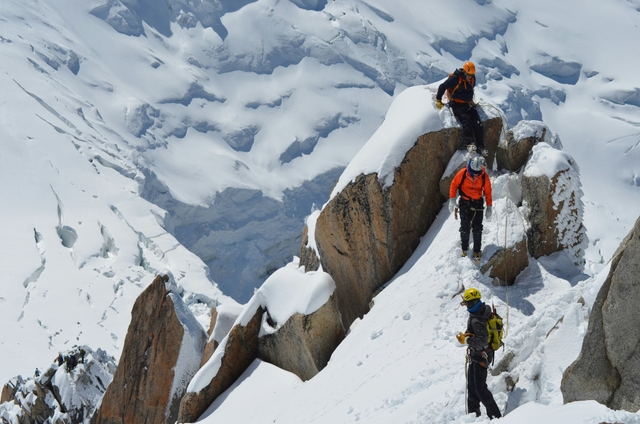
Technically: fluent use of jumars on fixed ropes, proficiency on steep ice (up to 55°), autonomous management of supplemental oxygen, cold injury prevention at altitude. The upper mixed sections aren't hard in absolute terms, but they become selective with numb fingers at 7800 m.
Essential equipment:
- Oxygen mask and regulator (Poisk or equivalent)
- Oxygen cylinders (3–4 for the summit attempt)
- Expedition down suit rated to −40°C
- Double boots for high altitude
- 12-point crampons, rigid frame
- Technical ice axe
- Jumar, descender, lightweight harness
- VHF radio — mandatory
Commercial expedition cost: between $15,000 and $35,000 USD, including Nepal climbing permit, local staff, oxygen, Base Camp services, and evacuation insurance.
Frequently Asked Questions
How much oxygen is there at Manaslu's summit?
At Manaslu's summit (8163 m), available oxygen is 34% of sea-level concentration. Barometric pressure drops to roughly 358 hPa versus 1013 hPa at sea level. Every breath delivers a third of the oxygen it would at the bottom of a mountain. Almost all commercial expeditions use supplemental oxygen above 7500 m.
Is Manaslu a good first eight-thousander?
It depends on your experience. Manaslu is often cited as one of the technically easier eight-thousanders — but it still requires solid ice-climbing skills, at least one seven-thousander on your résumé, and genuine understanding of high-altitude physiology. If you've never slept above 6000 m, you're not ready. Cho Oyu (8188 m) is generally considered a more gradual step before Manaslu.
What's the best season to climb Manaslu?
Two main windows: April–May (spring) and September–October (autumn). Spring historically sees more summit attempts, with slightly more stable weather windows than autumn. The monsoon (June–August) brings serious avalanche risk. Winter climbs are technically possible but rare.
How many people have summited Manaslu?
As of 2025, Manaslu has recorded over 700 summit ascents — one of the higher counts among eight-thousanders, reflecting the relative accessibility of its normal route. Historical mortality rate sits around 7%, declining significantly in recent years with better weather forecasting and widespread use of supplemental oxygen.
How long does a Manaslu expedition take?
A full expedition from Kathmandu takes 45–55 days: the approach trek to Samagaon (8–10 days), acclimatization rotations (3–4 weeks), and the summit attempt with descent. There are no reliable shortcuts for acclimatization — human physiology doesn't compress.
Is Manaslu dangerous for avalanches?
Yes. Manaslu carries a high avalanche risk profile — particularly in the C2–C3 section that crosses loaded slopes. The September 22, 2012 avalanche during a late-monsoon storm killed 11 climbers on the northeast face. This event made the climbing community significantly more cautious about timing and snowpack assessment. Serious expeditions now monitor snow stability continuously.
Access the complete guide for free
Enter your email and get immediate access + PDF download
What you need for Manaslu
Buying through these links supports Oxymeter at no extra cost to you — thank you! As an Amazon Associate, Oxymeter earns from qualifying purchases.
Indicative list. Adapt equipment to weather conditions and your experience level.
Has Oxymeter been useful to you?
Oxymeter is built by one person: servers, data and hours of work are all self-funded, and everything stays free with no ads. If you'd like to help, you can buy us a coffee.
Buy us a coffeeEven a small gesture makes a big difference. Thank you!
Open the page for up-to-date gear links: https://www.oxymeter.it/en/vetta/manaslu/
Sources and References
The information on this page has been verified from the following sources
Related peaks
Discover other peaks in the same area
Go deeper with our articles
Guides and tips to prepare yourself
Calculate your altitude sickness risk
7 questions — AMS risk estimate based on WMS guidelines