Mera Peak
Hinku Valley, Solukhumbu, Nepal
Oxygen Analysis — Oximeter
Oxygen comparison
Required Preparation
At 6476 m, with 44% oxygen available, perceived effort increases compared to sea level.
How to prepare
- Occasional training: this altitude requires mountaineering experience and specific preparation.
- Regular training: plan multiple days of progressive acclimatization at intermediate altitudes.
- Endurance training: physical fitness alone does not replace acclimatization at these altitudes.
- Consult a mountain medicine specialist before departure.
Route and Trail
Peak Guide
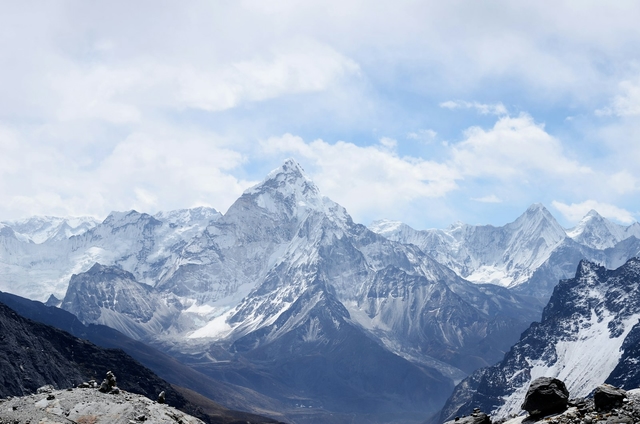
The Hinku Valley doesn't get the crowds. No Everest Base Camp queues, no organized trekking convoys. Mera Peak, at 6,476 metres, sits here — Nepal's highest officially registered trekking peak according to the Nepal Mountaineering Association. At the summit, oxygen is 44% of what you're breathing right now. On a clear day you see five of the world's highest mountains: Everest, Kangchenjunga, Lhotse, Makalu, and Cho Oyu. All at once. From above 6,000 metres.
The mountain has three distinct summits. Mera North at 6,476 m is the highest point. Mera Central at 6,461 m is what most climbers actually reach — the route is more direct and better established. Mera South at 6,065 m rarely draws a dedicated ascent. The first summit of Mera Central happened on 20 May 1953 — the same week Everest was first climbed — by Colonel J.O.M. Roberts and Sen Tenzing, nicknamed "The Foreign Sportsman." They were in Nepal supporting the Hunt expedition; they used the Hinku Valley as a side exploration.
Technically, the normal route is graded F/PD− in the French alpine scale. Maximum slope: 50°. There's no ice headwall requiring fixed ropes like on Island Peak. The real challenge is altitude, not technique. Getting to 6,476 m on a glacier demands proper acclimatization, mountaineering gear, and a minimum 12-day approach from Lukla. Anyone expecting an easy Himalayan tick gets schooled by the altitude. The altitude doesn't negotiate.
Technical Overview
| Data | Value |
|---|---|
| Altitude | 6,476 m (Mera North); Mera Central 6,461 m |
| Range | Mahalangur Himalaya — Hinku Valley, Solukhumbu |
| Country | Nepal |
| Difficulty | F/PD− — glacier travel, slopes up to 50° |
| Elevation Gain from Base | ~1,476 m (Khare ~5,000 m → Summit 6,476 m) |
| Ascent Time | 2 days from Khare: 6–8h + 5–7h to summit |
| Starting Point | Khare (Mera Base Camp, ~5,000 m) |
| High Camp | ~5,800 m |
| Oxygen at Summit | 44% of sea level |
| Typical Summit SpO₂ | 65–75% (acclimatized climbers) |
| NMA Permit | Required |
| First Ascent (Mera Central) | 20 May 1953 — Col. J.O.M. Roberts, Sen Tenzing |
| Best Season | April–May; October–November |
Route
You fly into Lukla (2,860 m) and begin a 7–9 day approach through the Hinku Valley. The route passes remote villages — Kothe (3,600 m), Thagnag (4,358 m) — and crosses the Zatrwa La pass (4,610 m) in the early days. This approach isn't overhead. It's the acclimatization that makes the summit possible.
Khare → Mera La → High Camp
~5,000 m → 5,415 m → ~5,800 m | Elevation gain: ~800 m | Time: 6–8h
From Khare, you climb toward Mera La (5,415 m), the glacial pass on the mountain's north side. Crampons go on here. The terrain shifts to glacier. High Camp sits at around 5,800 m on a snow platform. Most groups pitch tents here for an alpine start — a few hours of sleep before the pre-dawn departure.
High Camp → Summit
~5,800 m → 6,476 m | Elevation gain: ~676 m | Time: 5–7h
The summit push follows an open glacier with progressively steeper slopes. The final section toward Mera North's summit dome reaches 50°. It's not vertical. But at 6,400 m with atmospheric pressure at 450 hPa and legs that respond a half-second late, every step counts. Ice axe in hand the whole way. From the summit, on clear days, the Tibetan plateau stretches north and the Hinku Valley drops 3,000 metres below.
Route note: some guides use a camp at Mera La (~5,415 m) as an alternative to High Camp at ~5,800 m. Both options work; the choice depends on group acclimatization and glacier conditions.
Oxygen and Acclimatization
At 6,476 m, atmospheric pressure is roughly 450 hPa — 44% of sea level. Every breath carries less than half the oxygen you'd get at home. Resting heart rate goes up by 10–20 bpm in the first 48 hours at a new altitude. That's normal. What isn't normal: a headache that keeps getting worse, nausea, loss of coordination. At this altitude you don't wait overnight to see if it passes — you descend.
The good news: Mera Peak is climbed without supplemental oxygen by the vast majority of climbers. Someone arriving well acclimatized will register a summit SpO₂ typically between 65 and 75%. Not a reassuring number on paper. Perfectly functional on the mountain, with proper preparation. The rule is simple: don't gain more than 500 m of elevation per day above 3,000 m without at least one night of rest at the new altitude. No exceptions.
AMS risk is classified as high. The difference from an eight-thousander is that Mera Peak is achievable without oxygen by nearly all prepared climbers. "Achievable" doesn't mean "risk-free." Carry a pulse oximeter. Check it every evening in altitude. Anything below 75% SpO₂ at rest above 5,000 m warrants a conversation with your guide.
Medical note: This content is informational and does not replace consultation with a high-altitude medicine specialist.
Preparation
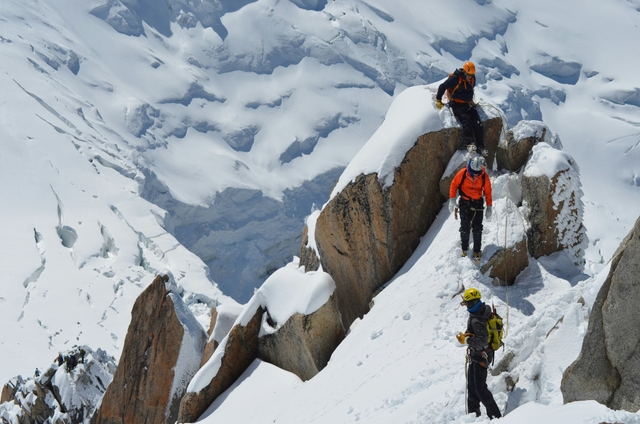
Mera Peak demands aerobic fitness more than technical skill. That said — walking on a glacier with crampons, using an ice axe for self-arrest, moving roped on glacier terrain — these are non-negotiable. Don't try to learn crampon technique at 5,500 m. An NMA-certified guide is legally required and practically essential for glacier safety.
Essential gear:
- 12-point crampons and technical ice axe
- High-altitude boots (double boots or equivalent)
- Down suit or expedition jacket (temperatures to −20°C at summit)
- Category 4 glacier glasses and high-factor sunscreen
- Harness and carabiners for rope travel
- Headlamp with spare batteries (pre-dawn departure from High Camp)
- Portable pulse oximeter for acclimatization monitoring
Season: April–May and October–November. The summer monsoon (June–September) makes glacier travel genuinely dangerous. October brings the most stable weather, settled snow, and maximum visibility. May works well for anyone combining Mera Peak with an Everest Base Camp trek.
Frequently Asked Questions
How much oxygen is there at Mera Peak's summit?
At Mera Peak's summit (6,476 m), oxygen is 44% of sea level. Atmospheric pressure drops to roughly 450 hPa versus 1,013 hPa at sea level. Every breath delivers less than half the oxygen you'd inhale at home. Almost all climbers summit without supplemental oxygen.
Is Mera Peak really Nepal's highest trekking peak?
Yes — with an important footnote. Mera Peak was long mistakenly listed at 6,654 m: that elevation belongs to Peak 41, a nearby summit that was incorrectly named "Mera" in an official trekking peak register. The correct height of Mera Peak (Mera North) is 6,476 m, confirmed by the Nepal Mountaineering Association.
What's the difference between Mera Peak and Island Peak?
Both are trekking peaks in the Khumbu region, but they're different climbs. Mera Peak (6,476 m) is higher and less technical — mostly open glacier with moderate gradients. Island Peak (6,189 m) is lower but more technical, with a fixed-rope ice headwall requiring jumars. Mera Peak suits climbers who want high altitude with less technical exposure; Island Peak is better for a true introduction to glacier alpinism.
Can I combine Mera Peak with the Everest Base Camp trek?
It's doable but needs planning. The Hinku Valley — where Mera Peak sits — isn't on the direct EBC route through the Khumbu Valley. Combining both requires crossing between valleys and roughly 25–30 days total. The acclimatization built during an EBC approach is a genuine advantage for the Mera Peak ascent.
Do I need technical experience to climb Mera Peak?
Yes. It's not extreme alpinism, but it's not trekking either. You need to walk competently on glacier with crampons, use an ice axe, and move safely while roped on glacial terrain. Anyone who has never used crampons should complete a basic glacier skills course before the expedition — not during it. An NMA guide is required by law.
Access the complete guide for free
Enter your email and get immediate access + PDF download
What you need for Mera Peak
Buying through these links supports Oxymeter at no extra cost to you — thank you! As an Amazon Associate, Oxymeter earns from qualifying purchases.
Indicative list. Adapt equipment to weather conditions and your experience level.
Has Oxymeter been useful to you?
Oxymeter is built by one person: servers, data and hours of work are all self-funded, and everything stays free with no ads. If you'd like to help, you can buy us a coffee.
Buy us a coffeeEven a small gesture makes a big difference. Thank you!
Open the page for up-to-date gear links: https://www.oxymeter.it/en/vetta/mera-peak/
Sources and References
The information on this page has been verified from the following sources
Related peaks
Discover other peaks in the same area
Go deeper with our articles
Guides and tips to prepare yourself
Calculate your altitude sickness risk
7 questions — AMS risk estimate based on WMS guidelines