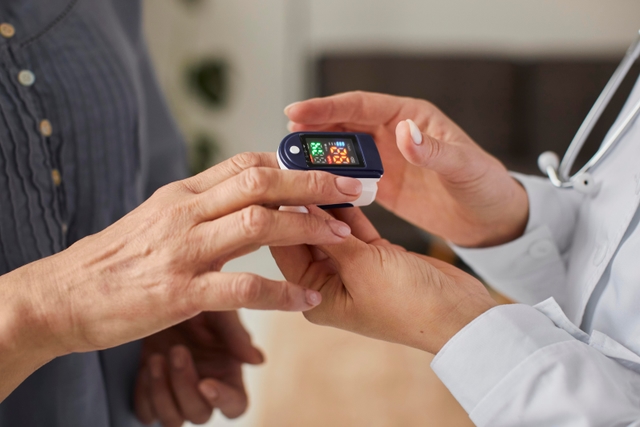
If you have COPD, a pulse oximeter isn't a nightstand gadget. It's one of the most useful home-monitoring tools you own — but using it well means understanding one thing first: your reference values aren't the same as a healthy person's.
This guide walks through how to measure correctly, when to act, which devices are worth buying, and — this is the part people skip — how to read the numbers in the context of your own disease.
If you live or spend time at altitude (above 500–800 m), keep in mind your baseline SpO₂ is already lower than at sea level. The Oxymeter calculator shows how much oxygen is actually available at your elevation.
Why the pulse oximeter matters so much in COPD
Chronic Obstructive Pulmonary Disease progressively damages the lungs' ability to exchange oxygen and clear carbon dioxide. Over time, many patients with moderate-to-severe COPD develop chronic hypoxemia: resting SpO₂ that sits consistently lower than in a healthy person.
Here's the problem. That hypoxemia can be silent. The body partially adapts to lower oxygen levels, and you might not notice much even at 88–91% SpO₂. This is exactly where a pulse oximeter earns its keep — it catches what symptoms often don't tell you.
What it can catch during critical phases
- Early flare-ups. A 3–5 point drop from your usual baseline can show up before the obvious symptoms of a flare — more coughing, more phlegm, more breathlessness.
- Bronchodilator response. If your SpO₂ rises after using your inhaler, the medication is doing its job.
- The need for oxygen therapy. If saturation keeps falling below the threshold your doctor set, it may be time to discuss home oxygen.
- Nocturnal desaturation. Some COPD patients desaturate during sleep without knowing it. A pulse oximeter with memory can catch this.
SpO₂ values in COPD are different — and this is the part people get wrong
In healthy people at sea level, normal SpO₂ runs 95–100%. For COPD patients, pulmonologists set individualized thresholds — usually lower:
| COPD stage (GOLD) | Typical SpO₂ when stable |
|---|---|
| Mild COPD (GOLD 1) | 94–97% (close to a healthy person) |
| Moderate COPD (GOLD 2) | 92–96% |
| Severe COPD (GOLD 3) | 88–94% |
| Very severe COPD (GOLD 4) | Often below 90% at rest |
The rule that matters most: don't compare your SpO₂ to a healthy person's numbers. Your pulmonologist will tell you your own baseline and the threshold at which you need to act.
The risk of too much oxygen in severe COPD
There's a specific paradox in advanced COPD worth knowing about.
In some patients with advanced disease, pushing SpO₂ up to 95–100% with supplemental oxygen can backfire. Certain patients rely on hypoxic drive to breathe — too much oxygen can actually suppress ventilation. That's why, in COPD, the goal of oxygen therapy is usually to keep SpO₂ within a specific range (typically 88–92%), not to maximize it.
Never adjust your supplemental oxygen on your own without medical guidance. Never.
How to measure SpO₂ correctly with COPD
Technique matters. A bad reading leads to bad decisions.
Steps for a reliable reading
- Sit and rest for at least 5 minutes before measuring — physical activity skews the result.
- Warm hands. Cold causes vasoconstriction and can produce readings 3–7 points lower than reality. If your hands are cold, rub them briskly or soak them in warm water for a minute first.
- No dark nail polish. It blocks the optical sensor.
- Use your index or middle finger on your dominant hand — not your thumb, which is less perfused.
- Stay still during the reading. Movement creates artifacts.
- Wait for stabilization (15–30 seconds) and note the value once the signal bar is full and steady.
- Note your heart rate too. SpO₂ and heart rate together tell you more than saturation alone.
When to measure
The recommended protocol for stable COPD is straightforward:
- In the morning, on waking, before your first medication and at rest.
- In the afternoon or evening, after the day's activities.
- Any time you notice more breathlessness, more coughing, or any new symptom.
- If you have a cold or a respiratory infection: every 4–6 hours, or as your doctor advises.
How to keep a pulse oximeter log
Measuring without logging is close to not measuring at all. A single reading tells you little — the trend over time is what gives your pulmonologist something to actually work with.
What to record at every measurement
| Data point | Why it matters |
|---|---|
| Date and time | To spot patterns — worse in the morning, worse at certain hours |
| SpO₂ (%) | The main value |
| Heart rate (bpm) | A secondary marker of cardiorespiratory strain |
| Prior activity | Whether you measured at rest, while walking, and so on |
| Symptoms | Breathlessness (1–5 scale), cough, fever, wheeze |
| Medication | Whether you took your bronchodilator before or after the reading |
How to keep the log
- A paper notebook. The simplest option. One column per data point works fine.
- A spreadsheet. Excel or Google Sheets lets you see trend charts over time.
- A health app. Apple Health, Samsung Health, or COPD-specific apps let you log values manually and generate reports for your doctor.
- Oximeters with built-in memory. Some models (Contec CMS50D Plus, Nonin GO2) store dozens or hundreds of readings you can download directly at your next appointment.
Recommended pulse oximeters for COPD
Monitoring COPD calls for a certified device. The price gap between a reliable pulse oximeter and an uncertified one runs €20–40 — negligible next to what the data is actually worth.
| Model | Approx. price | Certification | Why it works for COPD |
|---|---|---|---|
| Contec CMS50D | €25–40 | CE Class IIa | Reliable, compact, solid value for money |
| Beurer PO80 | €50–80 | CE Class IIa | Large display, easy to read even with visual difficulties |
| Nonin GO2 Achieve | €130–200 | FDA 510(k) | Clinically validated for low SpO₂ and darker skin tones |
| Contec CMS50D Plus | €35–55 | CE Class IIa | Data memory, useful for multi-day monitoring |
The Nonin GO2 is the recommended pick for severe COPD. It's the only consumer device with published clinical validation specifically for low SpO₂ readings — the range typical of advanced COPD (85–94%) — and for people with darker skin, where other oximeters tend to overestimate saturation.
What to avoid
Unbranded oximeters without CE or FDA certification can be off by ±8–15%. In a COPD context, that margin of error leads to the wrong call at the wrong moment. Smartwatches (Apple Watch, Garmin, Samsung Galaxy Watch) run about ±3–5% at the wrist — a useful complement, but not your primary source for clinical decisions.
When to act: warning signs in COPD
First things first: agree with your doctor, in writing, on your personal action thresholds. As a general reference:
| Situation | Recommended action |
|---|---|
| SpO₂ drops 3–4 points below baseline | Re-measure after 15 minutes. If it persists, call your doctor. |
| SpO₂ below the threshold your doctor set (often under 88%) | Call your doctor or follow your agreed flare-up protocol. |
| Persistent SpO₂ under 85% or severe symptoms | Go to the ER. |
| Heart rate over 100–110 bpm at rest with low SpO₂ | Go to the ER or contact a doctor immediately. |
| Confusion, cyanosis (blue lips or nails), disabling breathlessness | Call emergency services immediately. |
The 4-point rule
If your SpO₂ drops 4 or more points below your usual value across two readings taken 15 minutes apart, that's a warning sign. Regardless of the absolute number.
If your baseline is 91% and today you're at 87%, act — even though 87% isn't an emergency in the general population. The comparison that matters is against yourself, not a textbook table.
COPD and altitude: things to watch for
If you live in the mountains, hike, or climb, combining altitude with COPD needs extra care.
At 1,000 m, partial pressure of oxygen is about 90% of sea level. At 2,000 m, it drops to 82%. For someone with moderate-to-severe COPD, that can push an already-low baseline down further. The Oxymeter calculator shows the oxygen percentage available at your elevation — talk to your pulmonologist about adjusting your action thresholds depending on where you are or where you're headed.
Flying with COPD
Cabin pressure on a commercial flight is roughly equivalent to an altitude of 1,800–2,400 m. For moderate-to-severe COPD, that can lower SpO₂ by 2–5 points during the flight. If you fly regularly or have a long trip planned, ask your pulmonologist whether you need supplemental oxygen in the air. There's a specific assessment for this — the "fit-to-fly test" or hypoxia challenge test — that simulates cabin pressure conditions.
COPD and overnight pulse oximetry
Some COPD patients have episodes of nocturnal desaturation that don't show up during the day — particularly during REM sleep, when ventilation naturally drops. They may feel nothing at all. They just wake up tired, without knowing why.
If your doctor suspects nocturnal desaturation, they might recommend a pulse oximeter with continuous recording (some models log SpO₂ every 1–4 seconds through the whole night) or a formal sleep study. If nocturnal desaturation turns out to be significant, the options are CPAP, BiPAP, or overnight oxygen therapy.
A smartwatch with overnight SpO₂ tracking can be a useful first flag — but for formal clinical decisions, a fingertip pulse oximeter with data logging is still the standard.
FAQ
What's a normal oxygen saturation level for someone with COPD?
There's no single number that fits everyone. Your pulmonologist sets an individual target based on your stage and history. As a general guide: mild COPD (GOLD 1) around 94–97%; moderate (GOLD 2) around 92–96%; severe (GOLD 3) often 88–94% at rest. What matters most is knowing your own baseline and acting when it drops 3–4 points, not comparing yourself to a healthy person's numbers.
How often should I check my SpO₂ if I have COPD?
When stable: morning and evening. During a flare-up or a cold: every 4–6 hours, or as your doctor advises. Always check when a new symptom shows up or an existing one gets worse. A daily log turns isolated readings into a clinical picture your doctor can actually use.
Which pulse oximeter is best for COPD?
For mild-to-moderate COPD: the Contec CMS50D or Beurer PO80 (€25–80, CE Class IIa). For severe COPD or darker skin tones: the Nonin GO2 (€130–200, FDA 510(k)), clinically validated for low SpO₂ readings. Skip devices without CE or FDA certification, and don't rely on a smartwatch as your primary source.
When should I call my doctor about my pulse oximeter readings if I have COPD?
Call if your SpO₂ drops 4 or more points below your baseline, or falls under the threshold your doctor set (often below 88%). Go to the ER for persistent SpO₂ under 85%, confusion, cyanosis (blue lips or nails), or disabling breathlessness. For an emergency, call your local emergency number.
Do you use a pulse oximeter and spend time at altitude? The Oxymeter calculator shows how much air you actually have available at your elevation — and helps you understand how altitude interacts with your respiratory condition.