As an Amazon Associate, Oxymeter earns from qualifying purchases.
Here's a number that should bother you before your next big climb: at 14,000 feet, the air hands your lungs about 59% of the oxygen they get at sea level. Not 95%. Not 80%. Fifty-nine. And yet thousands of people walk onto Colorado 14ers and Mont Blanc every summer having never run that number, then wonder why the last 300 metres felt like wading through wet cement.
An altitude oxygen calculator fixes the guessing. You type in a target elevation, and it tells you the effective oxygen percentage, the SpO₂ your body is likely to read up there, and whether that altitude sits in a comfortable band or a risky one. Thirty seconds. No registration. The point isn't to scare you off the mountain — it's to walk up it knowing what's coming.
This guide shows you how to use the Oxymeter calculator to plan an ascent, what each number actually means, and where every calculator on earth stops being useful.
What an altitude oxygen calculator actually does
The oxygen fraction in the air never changes. At the summit of Everest it's still 20.9%, exactly what it is on a beach. That surprises people. The thing that collapses as you climb is air pressure — and pressure is what drives oxygen across the thin membranes of your lungs into your blood.
So a calculator isn't measuring some shrinking pool of oxygen molecules in percentage terms. It's modelling pressure. The Oxymeter tool uses the ICAO Standard Atmosphere, the same atmospheric model aviation has trusted for decades, to work out how much oxygen each breath effectively delivers compared to sea level. The formula behind it:
O₂% = 100 × (1 − 2.25577e-5 × altitude_in_metres)^5.25588
You don't need to touch that math. The calculator runs it. But it's worth knowing the engine under the hood is a physics standard, not a marketing estimate.
Three outputs matter. The effective O₂ percentage — how much oxygen you're getting versus the lowlands. The estimated SpO₂ — roughly what a pulse oximeter would show on an acclimatizing adult at rest. And the risk context — whether that elevation tends to leave people fine, tired, or in the early stages of acute mountain sickness.
How to use it — step by step
It's deliberately blunt to use. Four steps.
One: enter your target altitude. Feet or metres, your call. Use the actual summit elevation, not the trailhead. If you're climbing Mount Whitney, that's 14,505 feet, not the 8,360 feet where you park.
Two: read the O₂ percentage. This is the headline. Whitney returns about 58% of sea-level oxygen. That single figure reframes the whole day.
Three: read the estimated SpO₂. This is what your body is likely doing internally. At Whitney's altitude, an acclimatizing person commonly reads 80–86% at rest — numbers that would trigger an ambulance at sea level but are routine up high.
Four: read the risk band, then plan backwards. If your target sits in a high-risk band, that's your cue to build in acclimatization days, not to cancel. Climb high, sleep low. Add a night at altitude before the summit push.
Want the exact figure for a specific peak instead of a category? Enter it. The calculator handles anything from an 8,000-foot trail to the 29,032 feet of Everest.
Oxygen and SpO₂ by altitude — the reference table
Here's what the calculator returns across the elevations hikers and climbers actually care about. Every O₂% figure below is computed straight from the ICAO model.
| Altitude | Effective O₂ vs sea level | Typical resting SpO₂* | What it feels like |
|---|---|---|---|
| Sea level | 100% | 98–99% | Baseline |
| 5,000 ft (1,524 m) | 83% | 95–97% | Barely noticeable |
| 8,000 ft (2,438 m) | 74% | 92–95% | Heavier breathing uphill |
| 10,000 ft (3,048 m) | 69% | 89–92% | AMS starts appearing |
| 12,000 ft (3,658 m) | 64% | 84–88% | Real effort, poor sleep |
| 14,000 ft (4,267 m) | 59% | 80–86% | Colorado 14ers, hard work |
| Mont Blanc (4,808 m) | 55% | 78–84% | Sustained hypoxic load |
| 18,000 ft (5,486 m) | 50% | 74–80% | Half the oxygen. No permanent living |
| Denali (6,190 m) | 45% | 70–78% | Expedition territory |
| Everest (8,849 m) | 31% | 40–60%* | Death zone — bottled O₂ for most |
*SpO₂ ranges are population averages for acclimatizing people and vary widely between individuals. Everest figures reflect extreme, often supplemented, conditions.
Notice the slope. Between sea level and 8,000 feet you lose a quarter of your oxygen and most people shrug it off. Between 10,000 and 14,000 feet you lose another ten points and that's where the trouble clusters. For a deeper breakdown of these bands, see our full oxygen levels at altitude chart.
What the numbers actually mean for your body
A 59% reading doesn't mean you're running on 59% of your engine. Your body fights back, and that fight is the whole story of acclimatization.
Within hours of arriving high, you breathe faster and deeper. Within days, your kidneys ramp up red-blood-cell production to carry more oxygen per drop of blood. Give it a week and the same altitude that flattened you on day one feels workable. That's why the calculator's SpO₂ figure is a band, not a fixed value — an unacclimatized arrival and a week-deep climber can stand on the same summit and read ten points apart.
The danger isn't the low number itself. It's a low number plus symptoms, or a number that keeps sliding instead of stabilizing. SpO₂ at altitude is a guide, not a diagnosis.
Planning a US peak with the calculator
The American mistake is assuming that living in Denver prepares you for a 14er. It doesn't. Denver sits at 5,280 feet — 83% oxygen, basically comfortable. The summit of a Colorado 14er is at 59%. That's a 24-point collapse your weekend body has never met.
Run each one before you go. Mount Whitney, 14,505 feet, 58% oxygen. Mount Rainier, 14,411 feet, with a glacier approach that makes the thin air bite harder. The Colorado 14ers, clustered right at that 59% line. Denali is a different animal entirely — 20,310 feet, 45% oxygen, an expedition not a hike. We break these down peak by peak in our guide to oxygen levels on America's highest peaks.
The calculator gives you the number. The number gives you the respect to plan an honest ascent profile.
Where every calculator stops being useful
Be clear about the limits. A calculator models the atmosphere, not you.
It doesn't know your fitness, your hydration, whether you smoked for fifteen years, or that your cousin gets crushing headaches at 9,000 feet while you're fine at 13,000. AMS susceptibility is stubbornly individual and barely predictable from elevation alone. The SpO₂ figure is a population average — useful for knowing what's normal up there, useless as your personal vital sign.
Which is exactly why the calculator is step one, not the whole plan. Step two happens on the mountain, with a real device on your finger.
How to monitor your SpO₂ at altitude
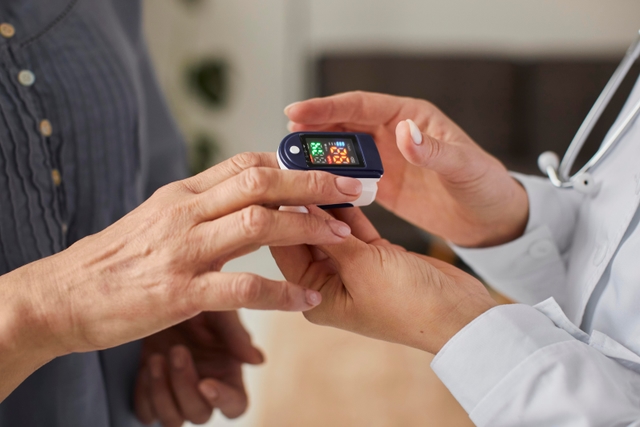
The calculator tells you what to expect. A pulse oximeter tells you what's actually happening. You want both.
A decent clip-on oximeter weighs nothing, costs less than a pair of socks for a climbing trip, and catches a falling SpO₂ trend hours before AMS symptoms announce themselves. Check it every morning at rest, log the number, and watch the trend rather than any single reading. A resting SpO₂ that drops each day instead of recovering is the mountain telling you to stop climbing. For which models actually hold up in cold and at altitude, see our tested guide to the best pulse oximeters for hiking.
The free Oxymeter calculator gives you the O₂ percentage and SpO₂ band for any altitude before you leave home. Pair it with an oximeter on the trail and you've covered both halves of the problem — what's coming, and what's real.
Frequently Asked Questions
Is there a calculator for altitude sickness risk?
Yes. The Oxymeter calculator estimates the oxygen percentage and likely SpO₂ at any altitude you enter, then flags the AMS risk band for that elevation. It won't diagnose altitude sickness — no calculator can — but it tells you which elevations historically push people into trouble so you can plan your ascent rate around them.
How do you calculate oxygen levels at altitude?
The oxygen percentage in the air stays at 20.9% all the way up. What drops is air pressure, and with it the number of oxygen molecules per breath. The Oxymeter calculator uses the ICAO Standard Atmosphere model — O₂% = 100 × (1 − 2.25577e-5 × altitude_m)^5.25588 — to give the effective oxygen available compared to sea level.
What percentage of oxygen is at 10,000 feet?
At 10,000 feet (3,048m), effective oxygen availability is about 69% of sea level. A healthy, acclimatizing adult will usually read an SpO₂ around 89–92% at rest. Above this elevation, AMS becomes common if you've ascended quickly.
What percentage of oxygen is at 14,000 feet?
At 14,000 feet (4,267m), oxygen availability falls to roughly 59% of sea level. Resting SpO₂ for an acclimatizing person typically sits at 80–86%. This is Colorado 14er and Mont Blanc territory — a real physiological load, not a rounding error.
How accurate is an altitude oxygen percentage calculator?
The atmospheric model is accurate to within a percent or two — it's the same Standard Atmosphere aviation relies on. The SpO₂ estimate is a population average, not a personal reading. Your own saturation depends on fitness, acclimatization, hydration and genetics, which is why you still carry a pulse oximeter.
What is the oxygen level at 8,000 feet above sea level?
At 8,000 feet (2,438m), oxygen availability is about 74% of sea level. That's the pressure most commercial aircraft cabins are set to. Most healthy people read an SpO₂ of 92–95% at rest and feel little more than slightly heavier breathing on the uphills.
How do I know if I have enough oxygen at altitude?
Two layers. Before you go, the calculator tells you the expected O₂% and SpO₂ band for your target altitude so you know what's normal up there. On the mountain, a pulse oximeter gives your actual reading. A resting SpO₂ that keeps falling, or sits below 80% with symptoms, is the signal to stop ascending.
This article is informational and does not replace medical advice. For climbs above 4,000m or if you have any cardiovascular or respiratory condition, consult a doctor trained in high-altitude medicine before you go.