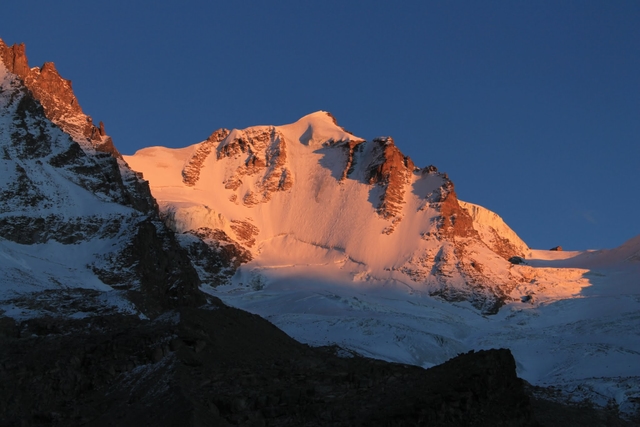
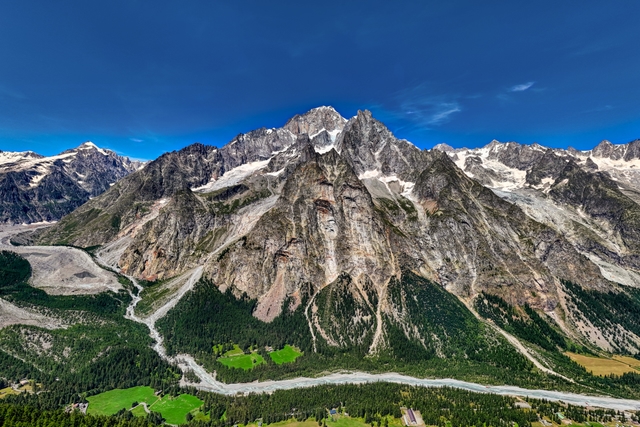
Mont Blanc (4,810 m) is the highest peak in Europe and one of the most sought-after mountaineering objectives. It is not technically extreme — the normal route (Voie des Trois Monts or Voie du Goûter) does not require difficult rock climbing — but it demands serious preparation. The hypoxia at 4,810 m, the cold (−10°C to −25°C at the summit in summer), the 10–14 hours of total climbing time, and the exposed ridges make it an ascent that punishes the unprepared.
At 4,810 m the available oxygen is 55% of sea level — every step near the summit requires twice the respiratory effort compared to the plains. You can verify expected pressure and SpO₂ values with the Oxymeter calculator.
The Ascent Profile: What to Expect
Normal route (Refuge du Goûter):
- Start: Les Houches or Les Contamines (~1,000 m)
- Refuge de Tête Rousse: 3,167 m
- Refuge du Goûter: 3,835 m (overnight)
- Vallot (emergency refuge): 4,362 m
- Bosses du Dromadaire: 4,547 m
- Summit: 4,810 m
- Total elevation gain from the trailhead: ~+3,800 m
- Elevation gain from Goûter night to summit: +975 m
- Time from Goûter overnight to summit and back: 7–10 hours
The Couloir du Goûter (between Refuge de Tête Rousse and Refuge du Goûter) is the most dangerous section: exposure to rockfall from the Aiguille du Goûter. It must be crossed early in the morning, before the sun melts the ice and loosens debris.
Fitness Level Required
Translating requirements into numbers is more useful than general descriptions:
| Parameter | Minimum requirement |
|---|---|
| Long hike | 6–8 hours with a 10–15 kg pack, 1,000+ m elevation gain |
| Estimated VO2max | ≥ 45 ml/(kg·min) to complete with relative comfort |
| Practical test | Gran Paradiso (4,061 m) or Breithorn (4,164 m) in a single day, without multi-day recovery |
| Cold | Tolerance of temperatures between −10°C and −25°C while moving |
| Technical | Autonomous use of crampons, ice axe, harness + basic glacier equipment |
VO2max is the maximum volume of oxygen the body consumes per unit of time. At altitude, available oxygen is reduced: at 4,810 m this is equivalent — as a physiological load — to having 55% of the VO2max you have at sea level. If your VO2max is 45 ml/(kg·min), at the summit you will effectively have approximately 25.
The Gran Paradiso test
The normal route of Gran Paradiso (4,061 m) is the most reliable benchmark. If you can ascend from Pont (1,960 m) to the summit and return in 7–9 hours without feeling exhausted, you are within the required fitness range for Mont Blanc. If Gran Paradiso takes more than 10 hours or leaves you with cramps for 3 days, there is more work to do.
12-Week Training Plan
This plan assumes an existing aerobic base (3–4 aerobic sessions per week). If starting from scratch, double the timeframe.
Block 1 — Weeks 1–4: Aerobic base and volume
| Week | Main activity | Volume | Notes |
|---|---|---|---|
| 1 | Running / hill hiking | 5–6h total | Low intensity (60–70% max HR) |
| 2 | Hiking with elevation gain | 6–7h + 1,000 m gain | 10 kg pack |
| 3 | Long weekend outing | 7–8h + 1,200 m gain | 12 kg pack, steady pace |
| 4 | Recovery | 4h, short sessions | Low intensity |
Block 2 — Weeks 5–8: Mountain-specific training
| Week | Main activity | Volume | Notes |
|---|---|---|---|
| 5 | Hiking with ridges and snow | 8h + 1,500 m gain | First crampon session on snow |
| 6 | Peak at 3,000–3,500 m | 9h + 1,800 m gain | Test acclimatization response |
| 7 | Peak at 3,500–4,000 m | 10h + 2,000 m gain | Gran Paradiso or Breithorn |
| 8 | Recovery + technique | 5h | Ice axe and crampon drills |
Block 3 — Weeks 9–12: Acclimatization and fine-tuning
| Week | Activity | Maximum altitude | Notes |
|---|---|---|---|
| 9 | Ascent to 4,000 m peak | 4,000–4,164 m | Breithorn or Gran Paradiso |
| 10 | Night at altitude (refuge 3,500+) | 3,500–3,835 m | Refuge du Goûter or equivalent |
| 11 | Controlled attempt | Up to 4,300–4,400 m | Bosses du Dromadaire without summit |
| 12 | Recovery + main attempt | 4,810 m | Primary summit attempt |
Acclimatization: How to Structure Preparatory Outings
The Mont Blanc acclimatization protocol does not require weeks at altitude (as for Aconcagua or Everest), but a few strategic outings make a meaningful difference.
Recommended sequence
- Peak at 3,000–3,500 m — First exposure to mild hypoxia. Matterhorn approach (3,883 m), Ortler (3,905 m), Monviso (3,841 m)
- 4,000 m peak — Gran Paradiso (4,061 m) is the classic benchmark. Tests individual hypoxic response
- Night at Refuge du Goûter (3,835 m) — Overnight acclimatization at 3,835 m is the best preparation for the summit. Many climbers do a "reconnaissance night" at the Goûter without attempting the summit
- "Climb high, sleep low" — In the week before the attempt, consider a night at low altitude (1,500–2,000 m) to recover and start fresh
Signs of good acclimatization
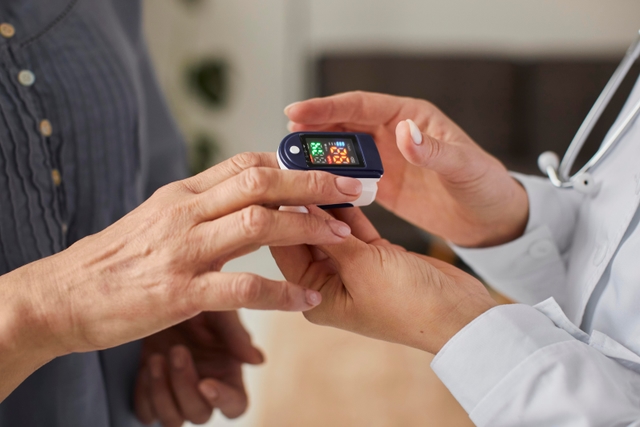
- Morning SpO₂ at the refuge ≥ 88–92% (measure with a pulse oximeter before getting up)
- No morning headache after the first night
- Recovery within 1–2 hours of arriving at the highest altitude
- Preserved appetite
Oxygen at 4,810 m: What to Expect
At 4,810 m the pressure is 559 hPa — available oxygen is 55% of sea level. Typical SpO₂ without acclimatization is 80–85%. With good acclimatization (2+ nights above 3,500 m) it rises to 87–91%.
What this means in practice:
- Walking is possible, but many climbers stop every 20–30 steps to catch their breath
- Perceived exertion is much higher than the actual work rate at sea level
- Concentration and reaction speed decrease — crucial on exposed traverses
- Digestion slows: favour light, easily digestible carbohydrates in the 12 hours before ascent
Use the Oxymeter calculator to compare oxygen values at different altitudes along the route.
Technical Equipment Specific to Mont Blanc
Beyond standard high-altitude clothing (see the complete equipment list), Mont Blanc requires:
| Equipment | Notes |
|---|---|
| 12-point crampons | Mandatory — automatic or semi-automatic models paired with rigid boots preferred |
| Ice axe | Classic 60–65 cm for snow and ice use |
| Harness | Mandatory for roped sections on the glacier |
| Rope | 30–40 m glacier rope if not going with a guide |
| Avalanche crampons | For the Couloir du Goûter in spring conditions |
| Helmet | Mandatory in the Couloir du Goûter (rockfall) |
| Pulse oximeter | To monitor SpO₂ at the refuge and decide whether to proceed |
| Headlamp | Summit departure is always at 2–4 AM |
| Sunglasses (category 4) | UV radiation at 4,810 m is 3–4× sea level |
Read more: All guides on mountaineering preparation
Frequently Asked Questions
How long does it take to prepare for Mont Blanc?
At least 3–4 months of structured preparation for those starting from an aerobic base. Those with experience above 3,500 m may be ready in 6–8 weeks. The programme includes aerobic training, significant elevation gain outings, and at least 2 acclimatization ascents to peaks above 4,000 m.
What fitness level is required?
You must be able to walk 6–8 hours with a pack and 1,000+ m of elevation gain without exhaustion. The best practical test is Gran Paradiso (4,061 m) in a single day. If you complete it without significant difficulty, you are within the required fitness range.
How do you acclimatize for Mont Blanc?
Complete at least 2 ascents to progressively higher alpine peaks (3,000 m then 4,000 m), then spend one night at the Refuge du Goûter (3,835 m) before the attempt. The "climb high, sleep low" system is the most effective strategy.
How much oxygen is at the summit of Mont Blanc?
At 4,810 m available oxygen is 55% of sea level. Typical SpO₂ is 80–85% without acclimatization, 87–91% with good acclimatization. It is an altitude you clearly feel: every step requires 2× the respiratory effort compared to the plains.
Before your attempt, check the oxygen values and estimated risk at your target altitude with the Oxymeter calculator.
For a complete equipment checklist, see the guide on what to pack for high altitude. For the full technical peak profile — route, acclimatization, typical SpO₂ — visit the Mont Blanc peak page.