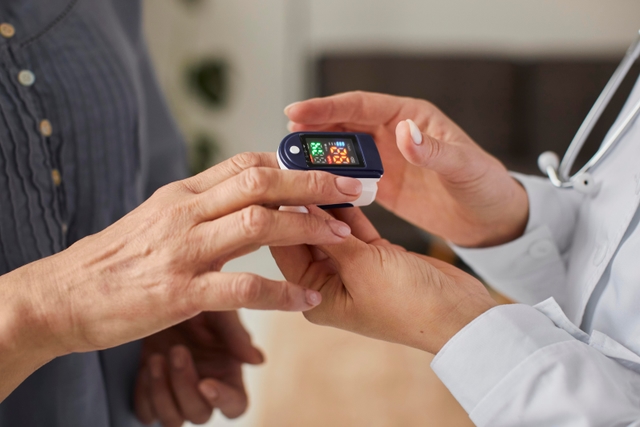
Sleep apnea affects a huge number of people — and most of them don't know it. One of its clearest fingerprints is nocturnal desaturation: your blood oxygen drops repeatedly through the night while you sleep, without you ever feeling it.
A pulse oximeter can be a genuinely useful tool for catching these drops and prompting a proper medical visit. But using it well overnight means understanding what's normal, what's a red flag, and which device actually gives you numbers you can trust.
If you live at altitude, keep in mind your baseline oxygenation is already lower than at sea level — even before sleep pulls it down further. The Oxymeter calculator shows exactly how much oxygen is available where you are.
What nocturnal desaturation is — and why it matters
During normal sleep, SpO₂ can drop slightly compared to waking values — especially in REM sleep, when ventilation naturally decreases. That's physiological. It's not a problem.
Pathological nocturnal desaturation is different. It shows up when:
- SpO₂ falls more than 3–4% below your baseline, repeatedly
- Episodes of SpO₂ under 90% last more than 5% of total sleep time
- There are sharp, repeated drops — more than 3–4 an hour — in a sawtooth pattern
These repeated drops put real strain on the cardiovascular system, break up restorative sleep, and over time can contribute to:
- High blood pressure, often resistant to standard treatment
- Cardiac arrhythmias — atrial fibrillation in particular
- Excessive daytime sleepiness and trouble concentrating
- Higher long-term cardiovascular risk
Signs you might have sleep apnea
You don't always need an oximeter to suspect apnea. These are the symptoms that come up most often.
What a partner usually notices at night
- Loud, irregular snoring
- Pauses in breathing — a partner sees you stop breathing for 10–30 seconds
- Gasping or snorting when breathing resumes
- Frequent movement or awkward sleeping positions to breathe better
What you notice during the day
- Excessive daytime sleepiness — nodding off in meetings, or worse, at the wheel
- Morning headaches
- Sleep that doesn't feel restorative, even after eight hours
- Trouble concentrating, memory lapses
- Irritability or mood swings
Risk factors
| Factor | Impact |
|---|---|
| Obesity (BMI > 30) | Higher risk — neck fat compresses the airway |
| Neck circumference > 40 cm (women) / 43 cm (men) | Direct risk marker |
| Male sex | 2–3 times more common in men |
| Age over 40 | Higher prevalence |
| Smoking | Inflames the upper airway |
| Alcohol before bed | Relaxes airway muscles |
| Menopause | Higher prevalence in postmenopausal women |
How to monitor nocturnal oxygenation at home
There are two practical device types for overnight SpO₂ monitoring.
Option 1: Fingertip oximeter with continuous recording
Accuracy: ±2–3% | Comfort: moderate — the clip stays on your finger all night
Certified fingertip oximeters with a recording function store SpO₂ and heart rate every 1–4 seconds through the whole night. In the morning, you download the data and look at the graph.
| Model | Approx. price | Memory | Notes |
|---|---|---|---|
| Contec CMS50D Plus | €25–45 | Yes (PC software) | Solid, affordable option for home tracking |
| Nonin GO2 Achieve | €130–200 | No | No recording — for spot checks only |
| Wellue O2Ring | €80–120 | Yes (mobile app) | Worn like a ring, more comfortable, slightly less precise |
The Wellue O2Ring is worth a look if the finger clip bothers you at night — it trades a touch of accuracy for comfort you'll actually tolerate for eight hours straight.
How to use it:
- Put the oximeter on your index or middle finger before bed
- Make sure the clip is snug but not tight
- Leave it on all night
- In the morning, download the data through the manufacturer's software or app
- Bring the graph to your doctor if you see episodes of SpO₂ under 90%
Option 2: Smartwatch with overnight SpO₂
Accuracy: ±3–5% | Comfort: high — you just wear it like a watch
Smartwatches with nocturnal SpO₂ tracking are by far the more comfortable option, though less precise. They read from the wrist, where the signal is naturally more variable.
| Device | App | Overnight SpO₂ | Alerts |
|---|---|---|---|
| Apple Watch Series 6+ | Health / Blood Oxygen | Yes (periodic) | No active alert |
| Samsung Galaxy Watch 4+ | Samsung Health | Yes (continuous) | Yes (configurable) |
| Garmin Fenix 7/8, Forerunner 965 | Garmin Connect | Yes (periodic) | Yes |
| Fitbit Sense 2 | Fitbit | Yes | Yes |
Watches report a summary — minimum, maximum, average, and sometimes the percentage of time below a threshold. If your overnight minimum regularly falls below 88–90%, that's your cue to talk to a doctor.
One night of low readings can just as easily be a bad reading from the watch. Don't panic over a single data point — look for a pattern.
What to look for in the overnight SpO₂ graph
If your recording oximeter or watch gives you a nightly graph, here's what actually matters.
A normal pattern
- SpO₂ stable between 94–100% for most of the night
- Small swings, under 3–4% between the highest and lowest values
- No sustained, abrupt drops
A pattern suggestive of sleep apnea
- Sawtooth drops: SpO₂ falls sharply by 5–15 points and recovers quickly, repeating several times an hour
- Frequent dips under 90% — especially more than five times an hour
- Prolonged drops: SpO₂ stays below 88% for several minutes at a stretch
A pattern suggestive of nocturnal COPD
- SpO₂ that falls gradually during certain sleep phases (especially REM) and recovers slowly
- No sawtooth pattern — the signature of apnea is missing
Altitude and nocturnal oxygenation
If you sleep above 1,500–2,000 m, your baseline nocturnal SpO₂ is already lower than at sea level — before apnea even enters the picture.
| Sleeping altitude | Expected nocturnal SpO₂ (acclimatized) |
|---|---|
| Sea level | 95–100% |
| 1,000 m | 93–98% |
| 1,500 m | 92–97% |
| 2,000 m | 90–96% |
| 2,500 m | 88–94% |
| 3,000 m+ | 85–92% |
The Oxymeter calculator shows the exact oxygen percentage available at your sleeping altitude. Use it to put your overnight graph in context — a dip that would be alarming at sea level can be entirely normal at 2,500 m.
Worth remembering: even at altitude, sleep apnea is real and desaturation episodes are still pathological. What changes is the baseline you're measuring against — not whether the condition exists.
When to see a doctor
Talk to a doctor — a GP, pulmonologist, or sleep specialist — if:
- You have three or more apnea symptoms (snoring, breathing pauses, daytime sleepiness)
- Your overnight oximeter graph shows repeated drops below 90% (or below the threshold expected for your altitude)
- Your partner has seen you stop breathing during sleep
- Daytime sleepiness is interfering with work or driving
- You already have high blood pressure, diabetes, or cardiovascular disease — apnea makes all three worse
Getting a formal diagnosis
Sleep apnea cannot be diagnosed with a home oximeter alone. A real diagnosis requires:
- Full polysomnography: an in-lab sleep study measuring SpO₂, airflow, breathing effort, EEG, ECG, and movement through the night
- Home sleep apnea test: a simpler, validated alternative your doctor can prescribe for moderate-to-high probability cases
Your doctor calculates the Apnea-Hypopnea Index (AHI):
- AHI < 5: normal
- AHI 5–15: mild
- AHI 15–30: moderate
- AHI > 30: severe
Treatment options
| Treatment | Indication | Effectiveness |
|---|---|---|
| CPAP | Moderate-to-severe apnea | High — normalizes nocturnal SpO₂ |
| Mandibular advancement device | Mild-to-moderate apnea, snoring | Moderate |
| Lifestyle changes | Mild apnea linked to obesity | Variable |
| Surgery | Specific anatomical obstruction | Selective |
CPAP — continuous positive airway pressure — is the most effective treatment for moderate-to-severe apnea. It typically wipes out nocturnal desaturation episodes from the very first night. If your doctor suspects apnea, this is usually where the conversation ends up.
FAQ
What's a normal SpO₂ during sleep?
In healthy adults at sea level: 90% or above for at least 95% of total sleep time. At altitude, the expected baseline is lower — see the table above. Frequent episodes below 90% at your expected baseline are a reason to see a doctor.
How do I measure oxygen levels during sleep at home?
With a fingertip oximeter that records continuously (Contec CMS50D Plus, Wellue O2Ring) or a smartwatch with overnight SpO₂ (Apple Watch Series 6+, Samsung Galaxy Watch 4+). The fingertip oximeter is more accurate; the watch is more comfortable.
Does sleep apnea lower blood oxygen?
Yes. During apnea episodes, SpO₂ can drop 10–30 points — sometimes below 80% in severe cases. An overnight oximeter picks these up as repeated sharp drops on the graph.
Can a smartwatch diagnose sleep apnea?
No. Watches can flag signals consistent with apnea — desaturations, heart rate changes — but a real diagnosis needs a polysomnography or home sleep study interpreted by a doctor.
Do you sleep at altitude and want to understand your nocturnal oxygenation? Use the Oxymeter calculator to see how much oxygen is actually available at your elevation — and compare it against expected values before you read too much into your oximeter's numbers.