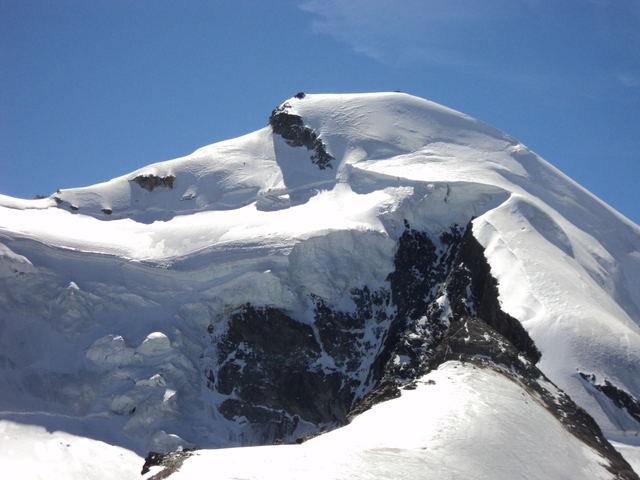
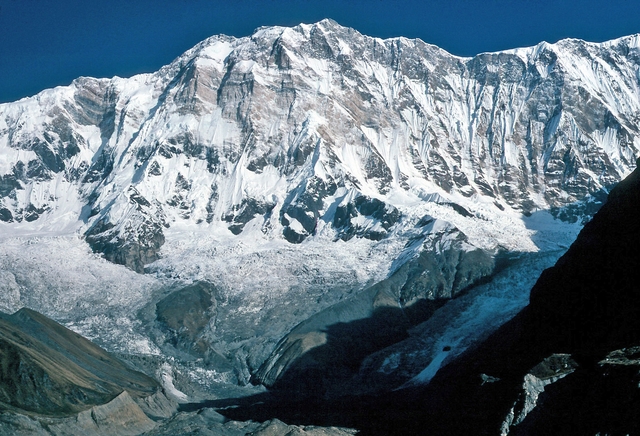
Matterhorn
Pennine Alps, Italy/Switzerland
Oxygen Analysis — Oximeter
Oxygen comparison
Required Preparation
At 4478 m, with 57% oxygen available, perceived effort increases compared to sea level.
How to prepare
- Occasional training: specific preparation and progressive acclimatization are required before the summit.
- Regular training: plan acclimatization stops and monitor oxygen saturation.
- Endurance training: respect physiological adaptation times even if fitness level is high.
- Consider a sports medical assessment before the ascent.
Route and Trail
Peak Guide
The noblest crag in Europe, as John Ruskin called it. A pyramid of rock and ice that slices the sky at 4478 meters on the border between Italy and Switzerland, the ultimate symbol of alpinism and the stage of the most famous tragedy in the history of Alpine conquest. The Matterhorn — Cervino to the Italians — is no ordinary mountain: it has two distinct normal routes, two summit crosses mere meters apart, and a history steeped in rivalry, heroism, and drama.
Quick Facts
| Detail | Value |
|---|---|
| Altitude | 4478 m a.s.l. |
| Mountain group | Pennine Alps, Matterhorn Massif |
| Names | Cervino (IT), Matterhorn (DE), Mont Cervin (FR) |
| Summits | Italian Cross (west) and Swiss Cross (east), linked by a short ridge |
| Italian normal route | Lion Ridge — D (Difficult), IV- |
| Swiss normal route | Hörnli Ridge — AD (Fairly Difficult), III |
| Elevation gain (Lion Ridge) | ~643 m from Capanna Carrel (3835 m) |
| Elevation gain (Hörnli Ridge) | ~1218 m from Hörnli Hütte (3260 m) |
| Ascent time | 4–5 hours from each hut |
| Recommended season | July – September |
| Italian starting point | Breuil-Cervinia (2006 m) → Capanna Carrel (3835 m) |
| Swiss starting point | Zermatt (1620 m) → Hörnli Hütte (3260 m) |
Two Normal Routes, Two Souls of the Mountain
The Matterhorn is unique among the great Alpine peaks: there is not one normal route but two, each with its own character, history, and support hut. The Lion Ridge (Italian southwest face) and the Hörnli Ridge (Swiss northeast face) compete for the title of classic itinerary, offering radically different experiences while leading to the same summit.
Lion Ridge — Italian Normal Route
The more technical of the two, Carrel's route. You start from Breuil-Cervinia and climb to Capanna Carrel (3835 m), the last outpost before summit day. The route involves rock climbing up to grade IV-, with fixed-rope sections and iconic passages such as the famous Cheminée and the dizzying Scala Jordan, a vertical wall fitted with metal rungs that deposits the climber just steps from the Italian cross. Overall difficulty: D (Difficult). The ridge offers a severe, athletic experience with breathtaking exposure on the south face and continuous scrambling on rock that is not always solid.
Hörnli Ridge — Swiss Normal Route
The route of the first ascent, Whymper's route. From Zermatt you climb to the Hörnli Hütte (3260 m), a historic hut nestled at the base of the northeast ridge. The route is longer in terms of elevation gain but less technical: passages reach grade III with some fixed-rope sections. Overall difficulty: AD (Fairly Difficult). It remains a serious and demanding climb, made treacherous by summer overcrowding and the constant risk of rockfall triggered by parties above.
Two Summits, Two Crosses
The summit ridge of the Matterhorn hosts two high points separated by just a few meters: the Italian Cross (west side, reached from the Lion Ridge) and the Swiss Cross (east side, reached from the Hörnli Ridge). The height difference between the two is negligible — a matter of decimeters — and the national border runs along the narrow ridge connecting them. Reaching both is a symbolic gesture that many climbers perform.
Pic Tyndall (4241 m)
Along the Lion Ridge you encounter Pic Tyndall, a secondary shoulder at 4241 m named after the Irish physicist John Tyndall, who in 1863 was stopped at this very point by the rocky notch separating him from the summit. Pic Tyndall is recognized as one of the official Alpine four-thousanders and constitutes a mandatory waypoint on the Italian route.
Oxygenation and Acclimatization
At 4478 meters barometric pressure grants only 57% of the oxygen available at sea level. The Matterhorn places the climber squarely in the high-altitude zone, where hypoxia bites hard and Acute Mountain Sickness is a concrete risk for anyone who has not invested the necessary time in acclimatization.
Typical summit SpO₂ for a well-acclimatized individual ranges between 72 and 78% — values that demand a disciplined, steady pace with no surges. The specific challenge of the Matterhorn is that its technical difficulties force rapid movements and intense efforts — vertical scrambles, exposed traverses — precisely when the body would need to proceed calmly. This conflict between technical demand and physiological need makes breath management critical.
Adopt diaphragmatic breathing during every rest: inhale through the nose for four seconds, exhale through the mouth for six. On the most demanding passages, use pressure breathing — exhale forcefully against nearly closed lips to maintain alveolar pressure and counteract edema. If you experience a hammering headache that does not ease with hydration, confusion, loss of coordination, or a dry persistent cough, the only safe option is to lose altitude immediately.
Note: This advice is informational and does not replace medical consultation. Consult a physician specializing in high-altitude medicine before undertaking demanding ascents.
The Ascent
Via Lion Ridge (Italian Side)
Day 1: From Breuil-Cervinia to Capanna Carrel From the parking area at Breuil-Cervinia (2006 m) you ascend the valley to the Rifugio Duca degli Abruzzi all'Oriondé (2802 m), an optional intermediate stop. From here the route becomes serious: the ridge turns rocky and the first climbing passages lead through airy ledges and gullies to Capanna Carrel (3835 m), clinging to the wall like an eagle's nest. The total elevation gain exceeds 1800 meters and the ascent takes between 5 and 7 hours.
Day 2: Conquering the pyramid Departure at dawn. The ridge steepens with progressively more technical passages. You tackle the Cheminée, a vertical chimney demanding arms and lungs, then the Testa del Leone with its exposed slabs. You pass through Pic Tyndall (4241 m), overcoming the notch that stopped Tyndall in 1863. The final stretch is the most spectacular and the most feared: the Scala Jordan, a series of metal rungs driven into vertical rock that deposits the climber directly on the summit ridge, mere steps from the Italian Cross. Time from Capanna Carrel to the summit: 4–5 hours. The descent demands equal concentration.
Via Hörnli Ridge (Swiss Side)
Day 1: From Zermatt to Hörnli Hütte From Zermatt (1620 m) you take the cable car to Schwarzsee (2583 m) and hike from there to the Hörnli Hütte (3260 m), roughly 1.5 hours on trail. The hut, historically linked to the first ascent of 1865, provides the launching point for the northeast ridge.
Day 2: The ridge of the first ascent Departure in the dead of night, around 4 a.m. The Hörnli Ridge climbs straight and relentless for over 1200 meters of elevation gain, alternating rock scrambling (up to grade III) with mixed sections. The route is marked by fixed ropes at key points and paint blazes. Technical difficulty is lower than the Lion Ridge, but the length of the commitment and summer crowding more than compensate: rockfall triggered by parties above is a constant hazard. After 4–5 hours of unceasing ascent you reach the Swiss Cross at the summit.
Physical Preparation
The Matterhorn is not a mountain for beginners. Both normal routes require solid mountaineering experience, confidence on exposed rock up to grade III–IV, familiarity with high altitude, and the physical stamina to sustain 8–12-hour days of vertical activity under hypoxic conditions.
| Starting level | Preparation time | Key Phases |
|---|---|---|
| Average Alpinist | 3–6 months | Complete at least two four-thousanders (Gran Paradiso, Breithorn). Rock climbing up to grade IV. Planned acclimatization. |
| Expert Alpinist | 4–8 weeks | Targeted outings on mixed ridges. Verify physical endurance on 1500m+ elevation gains at altitude. |
Those who have never scrambled on exposed rock at altitude must acquire this skill before attempting the Matterhorn. A recommended preparatory climb is Gran Paradiso, followed by Castore or Breithorn to test high-altitude tolerance.
Equipment
The Matterhorn is a complete mountaineering ascent. Every piece of equipment serves a vital function.
Essential:
- Certified alpine helmet — rockfall is a real hazard on both ridges
- Harness with daisy chain, rope (minimum 30 m), and locking carabiners
- Sharp 12-point crampons on rigid high-mountain boots
- Ice axe and set of cams and nuts (for the Lion Ridge)
- Slings and runners for self-belaying on fixed ropes
Recommended:
- Waterproof shell and compressible down jacket — weather can change in minutes
- Double-layered gloves and balaclava
- Category 4 sunglasses
- Thermos with a hot drink and energy bars
- Pocket pulse oximeter to monitor SpO₂ during the ascent
Historical Notes and Curiosities
The history of the Matterhorn is the history of heroic alpinism itself. For centuries the mountain was called Gran Becca by local populations and deemed absolutely inaccessible. It was the last great Alpine peak to be conquered, and its fall officially marked the end of the Golden Age of Alpinism (1854–1865).
The race to the summit was dominated by the rivalry between Englishman Edward Whymper and Aosta Valley guide Jean-Antoine Carrel. Whymper attempted both sides repeatedly between 1861 and 1865, often accompanied by Carrel himself. In 1865 the tension erupted: Carrel was leading an Italian expedition funded by Quintino Sella via the Lion Ridge, while Whymper, excluded from the Italian attempt, moved to Zermatt to attack the Hörnli Ridge.
On July 14, 1865, Whymper's party — with Michel Croz, Charles Hudson, Lord Francis Douglas, Douglas Hadow, and the Taugwalders father and son — reached the summit via the Hörnli at 1:40 p.m., beating Carrel by three days. But the descent turned to tragedy: the inexperienced Hadow slipped, dragging Croz, Hudson, and Lord Douglas with him. The rope snapped and the four fell over a thousand meters down the north face. Only Whymper and the two Taugwalders survived. The broken rope is now displayed at the Alpine Museum of Zermatt.
Three days later, on July 17, Carrel completed the first ascent of the Lion Ridge with Jean-Baptiste Bich, Abbé Amé Gorret, and Jean-Augustin Meynet, proving that the Italian side was also possible.
Other key milestones:
- 1931 — First ascent of the terrifying north face, one of the so-called "great north faces" of the Alps
- 1965 — Walter Bonatti completed the first solo winter ascent of a new route on the north face, considered one of the greatest feats in the history of alpinism
- The Matterhorn became the logo of Toblerone and a universal symbol of Switzerland, despite being half Italian
⚠️ Medical disclaimer: The information provided is indicative and based on general physiological data. It does not replace the advice of a physician specializing in high-altitude medicine. Consult a professional before high-altitude excursions.
Sources and References
The information on this page has been verified from the following sources
Related peaks
Discover other peaks in the same area